

10 signs that you might have a Morton’s neuroma
During the Covid-19 Pandemic, many have found it hard access assessment and treatment for their suspected Mortons Neuroma. This is a shame as the following blog illustrates that Morton’s neuroma is easily self-diagnosed, and cryosurgery is accessible during the pandemic as a treatment option.
Morton’s neuroma is a relatively easy condition to self-diagnose and is one of the rare conditions that Dr Google can help you with. If you Google ‘Morton’s neuroma signs and symptoms’ the same set of signs and symptoms come up time and time again, this is because Morton’s neuroma does seem to generate very consistently the same kind of features for sufferers. Even the presence of just one sign can be enough to aid the diagnosis and if two or more signs are present it is highly likely there is Morton’s neuroma lurking in your foot or possibly a similar associated condition called bursitis.
Table of Contents
What are these signs and symptoms?
- Tingling or pins and needles in the toes, commonly the 3-4th toes or the 2-3rd (we number your toes, your big toe is number 1- and little toe is number 5). The tingling for most will begin after a period of walking or standing or even cycling or wearing a particular pair of shoes. The period of time the tingling takes to come on can be quite variable from person to, for some the tingling is felt after only a few minutes for others as long as 40-60 minutes.
- A burning pain felt in the forefoot region, often when wearing slightly narrower shoes, or ski boot or climbing shoes.
- stabbing pains can often come on quite randomly and can often stop you dead in your tracks.
- A clicking sensation, felt in the ball of the foot, just behind the toes, the sensation is actually the enlarged nerve moving literally up and down in the forefoot. It can be quite a strange and uncomfortable sensation. In medicine the click has a name, it’s called the Mulder click, named after the doctor who first wrote about the association between the click and the presence of Morton’s neuroma. The presence of a Mulder’s click is a 98% reliable indicator of the presence of a large Morton’s neuroma, 100% of those with Morton’s neuroma will experience tenderness if the when the forefoot is palpated with moderate pressure (1). Another reliable test is the pinch test, where the space between the metatarsals that contain the neuroma is pinched between the thumb and the index finger, the presence of pain when the metatarsal interspace is pinched indicates the presence of Morton’s neuroma in 96% of cases (2).
- A sense of fullness in the ball of the foot. This is because the nerve has enlarged and is occupying space that it wouldn’t normally occupy. A sense of fullness can also indicate the presence of intermetatarsal bursitis. Approximately 40% of patients with Morton’s neuroma have associated bursitis or a sack of thick fluid around the nerve.
- The urge to remove your shoe and massage the ball of the foot is a giveaway sign of Morton’s neuroma.
- Have you ever had the sensation that you have somehow put your sock on incorrectly or that the seam of the sock is in the wrong place or that the sock has bunched up beneath your toes? Only, when you inspect the sock you find it’s ok. The nerve playing sock tricks on you is another sign you have Morton’s neuroma. More rarely people with neuromas report a papercut sensation between the toes when there actually is no cut, and the sensation that there is bleeding between the toes when on inspection there is no bleeding.
- A ‘v’ shaped splaying of the toes either side of the neuroma is another common telltale sign that you have a large Morton’s neuroma. This sign is called the Sullivan’s or the Star Trek sign.
- A sensation of having a stone in your shoe, is a very classic Morton’s neuroma give away.
- Numb toes, mainly the 3rd and 4th toes and sometimes the 2nd and 3rd toes. The numbness is caused by demyelination of the nerve and compression of the central part of the nerve called the axon. Myelin is a lipid-rich (fatty) insulating layer that allows electrical impulses called action potential to travel along the nerve. People with Morton’s neuroma suffer a gradual loss of healthy myelin. The myelin is gradually replaced by a proliferation of inflammatory cells and tissue that form the lump that is Morton’s neuroma, and the loss of normal sensation. Even though sensation is lost the nerve annoyingly still retains the ability to generate pain especially when the axon is compressed by the diseased tissue.
The good news:
After cryosurgery, the diseased tissue breaks down and the myelin sheath regenerates allowing for normal pain-free sensation to return. Typically, all of the signs listed above disappear, including the clicking, tingling and stabbing burning pains, and the Star Trek sign.
To paraphrase Star Trek
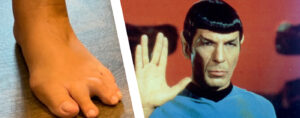
Don’t let your Morton’s neuroma be a Klingon instead have cryosurgery and live long and prosper.’
At The Barn Clinic Centres we are still offering:
- Remote consultation to discuss suspected diagnosis and cryosurgery.
- Prior to any treatment, all patients receive a detailed face to face examination and Ultrasound Scan.
References
- Pastides P, El-Sallakh S, Charalambides C. Morton’s neuroma: A clinical versus radiological diagnosis. Foot Ankle Surg. 2012 Mar;18(1):22-4. doi: 10.1016/j.fas.2011.01.007. Epub 2011 Feb 16. PMID: 22325999.
- Mahadevan D, Venkatesan M, Bhatt R, Bhatia M. Diagnostic Accuracy of Clinical Tests for Morton’s Neuroma Compared With Ultrasonography. J Foot Ankle Surg. 2015 Jul-Aug;54(4):549-53. doi: 10.1053/j.jfas.2014.09.021. PMID: 25432459.
Fill in our form and we’ll be in touch in 24 hours

Mr Weaver has a special clinical interest in podiatric regenerative medicine and was among the first clinicians in Europe—and the first in the UK—to offer cryosurgery (cryoablation) for Morton’s neuroma. Driven by a commitment to excellence in patient care, he focuses on delivering precise, evidence-based treatments that prioritise long-term recovery and patient comfort.
Over the past 18 years, he has performed approximately 20,000 procedures for Morton’s neuroma and bursitis. This extensive experience allows him to provide a highly personalised approach, ensuring every patient receives the specialist attention required for the best possible outcomes.
His professional memberships include the Institute of Podiatrists, the International Society of Cryosurgery, and the British Medical Ultrasound Society.