
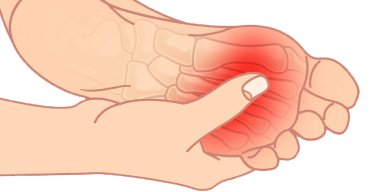
Morton’s Neuroma and Bursal Complex. Which treatment is best?
Table of Contents
What is bursal complex and what is the best treatment?
There are approximately 150 bursae (the plural for bursa) throughout the body. Bursa tend to be described in the medical literature as synovial fluid-filled sacs that function as cushions or buffers, separating and protecting tendons, ligaments, and nerves. The synovial fluid inside the bursa has the same kind of consistency as KY gel, which helps the bursa deflect compressional forces and aid buffering. Often these protective structures rather than protecting, ultimately become part of the problem as they become inflamed, a process known as bursitis. Bursitis tends to be a painful condition, often resulting in scar tissue within the bursa.
Bursitis in the forefoot is generally induced by mechanical factors or repetitive stresses. Wearing shoes that are too tight is one of the most common causes. However, intermetatarsal bursitis can sometimes be triggered by other underlying medical conditions such as rheumatoid arthritis or gout. Approximately 70% of those with rheumatoid arthritis develop intermetatarsal bursitis.
Prior to 2016, many regarded bursitis as a separate entity to Morton’s neuroma
Prior to 2016, many regarded bursitis as a separate entity to Morton’s neuroma. This is because anatomically the bursa normally sits above the nerve in what’s referred to as the upper or dorsal compartment.
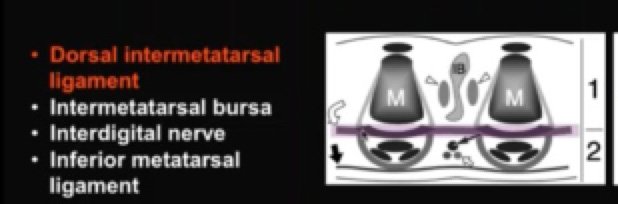
A 2016 paper entitled “Sonography of Morton’s neuromas – What are we really looking at?” showed that the situation is really more complicated and involves a much closer integration of inflamed scarred bursal tissue and enlarged inflamed nerve tissue.
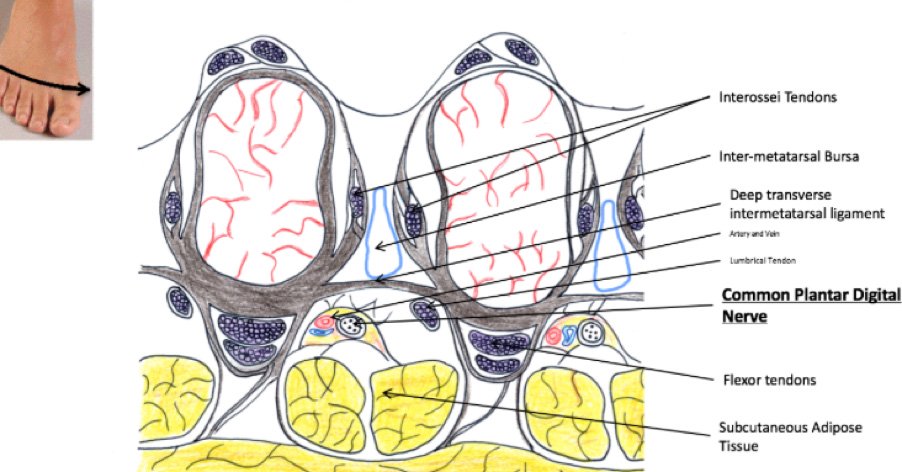
In the ‘textbook’ like diagram above, you can see the metatarsal bones in cross-section, and the deep transverse metatarsal ligament seen in purple. The nerve is shown to sit below the ligament in the lower plantar compartment with the bursa siting above. The reality, actually differs from this neat textbook depiction. In reality, the enlarged bursa sitting above the nerve pushes down and sometimes through the deep metatarsal transverse ligament which in turn sags downwardly and compresses the interdigital nerve from above.
The Bursal tissue seems to, in many cases, be able to communicate with the neuroma below. The neuroma is frequently tangled up in inflammatory bursal scar tissue. Not only is the neuroma entangled in bursal tissue and the abnormal blood vessels that feed this tissue, but additionally there is a proliferation of inflammatory cells that invade the myelin sheath of the nerve. A.K.A. a Morton’s neuroma.
The term ‘Morton’s neuroma complex’ was coined after publication of the paper mentioned above in 2016 (1).
Our experience is that approximately 60% patients have only a single neuroma or a single bursa, but about 40% have a combination of both.
How is bursitis treated?
Rest, icing and taking anti-inflammatory tablets (such as ibuprofen, aspirin or diclofenac), physiotherapy and steroid injections are the usual ways of treating bursitis.
Historically, painful persisting intermetatarsal bursa were often injected with Steroid, directed into the bursal tissue with ultrasound guidance. Steroid can be very helpful at settling the inflammation down reducing the excessive quantities of synovial fluid that fill them. However, there is a limit of 2-3 steroid injections to the same area due to risks, such as ruptured ligaments and loss of protective fat tissue.
Treatment for bursitis
A better treatment for bursitis is a modern treatment that utilises Platelet Rich Plasma or PRP for short (2). PRP, is derived from the blood of the patient, and as such, harnesses the body’s natural repair mechanisms. PRP injections seem to be able to ‘trick’ the body into taking a ‘new look’ and direct greater healing resources to the area that has been injected. The process then triggers tissue remodelling and regeneration. The Barn Clinic treatment centres in Harley Street London and Sheffield use a PRP system that focuses on monocytes.
Monocytes are specialist white cells that can release enzymes promoting the breakdown of abnormal diseased tissue, paving the way for tissue repair. Monocytes can also help address the scarring in bursal tissue which is a big advantage over steroid. Monocyte cells have a similar effect on muscle, ligament and tendon injuries throughout the body.
At the Barn Clinic we have found the best treatment overall treatment for painful bursa or Morton’s neuroma is cryosurgery. A published bursitis study compared 90 patients who received the usual treatments for bursitis with 70 patients that received cryosurgery for bursitis. At 1-2 years follow-up, 51 % of patients treated with steroid injections etc had experienced a relapse of their symptoms compared to a 0% relapse rate of the 70 patients treated with cryosurgery (3).
Again, our experience over the last 15 years has been that cryosurgery has regenerative effects on both Morton’s neuroma and bursitis and offers an excellent solution to an otherwise difficult to treat problem.
The take away points:
- 40% of Morton’s neuroma have abnormal inflamed, scarred bursal tissue surrounding them.
- In our view, PRP is a new superior treatment option to steroid injections for a single bursa.
- Cryosurgery is effective for treating both bursa and Morton’s neuroma.
References:
- Cohen SL, Miller TT, Ellis SJ, Roberts MM, DiCarlo EF. Sonography of Morton Neuromas: What Are We Really Looking At? J Ultrasound Med. 2016 Oct;35(10):2191-5. doi: 10.7863/ultra.15.11022. Epub 2016 Aug 25. PMID: 27562973.
- Platelet-rich plasma (PRP) treatment is more effective than cortisone for severe hip bursitis, according to a study presented at the 2014 Annual Meeting of the American Academy of Orthopaedic Surgeons (AAOS).
- Goriachev AN, Ivashchenko NN, Potapov IuA. Lechenie khronicheskikh bursitov metodom lokal’nogo kriovozdeĭstviia [Treatment of bursitis by a local cryogenic procedure]. Vestn Khir Im I I Grek. 1988 Jan;140(1):128-31. Russian. PMID: 3381387.
Mr Weaver has a special clinical interest in podiatric regenerative medicine and was among the first clinicians in Europe—and the first in the UK—to offer cryosurgery (cryoablation) for Morton’s neuroma. Driven by a commitment to excellence in patient care, he focuses on delivering precise, evidence-based treatments that prioritise long-term recovery and patient comfort.
Over the past 18 years, he has performed approximately 20,000 procedures for Morton’s neuroma and bursitis. This extensive experience allows him to provide a highly personalised approach, ensuring every patient receives the specialist attention required for the best possible outcomes.
His professional memberships include the Institute of Podiatrists, the International Society of Cryosurgery, and the British Medical Ultrasound Society.