

Stepping back in time: A brief history of Cryosurgery in Medicine & a look at why it’s the ideal treatment for Morton’s Neuroma today.
Table of Contents
Introduction
In terms of safety, efficacy, and ease of patient recovery, cryosurgery in my view represents an unparalleled treatment modality for the treatment of Morton’s neuroma. No other treatment comes close, and yet there is still some misconception that cryosurgery is somehow new and untested. This blog gives a brief glimpse into the history of this fascinating treatment and describes why a treatment that is used for cancer is also good news for Morton’s neuroma sufferers.
When it comes to Morton’s neuroma, if you could wave a magic wand and ask a clinician for an ‘if only’ wish list it would include the following:
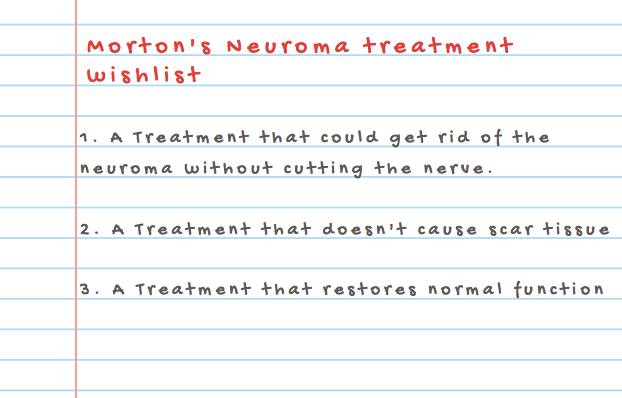
Thankfully, we don’t need a magic wand as there is already a treatment that does all of this.
It’s called cryosurgery, it’s a niche treatment that has a rich heritage.
A Brief history
Cryosurgery, sometimes referred to as cryotherapy or cryoablation, is a treatment technique in which extreme cold is used to destroy diseased tissues. The prefix “cryo” is derived from the Greek word “kruos” for cold and usually refers to temperatures below -20 degrees Celsius.
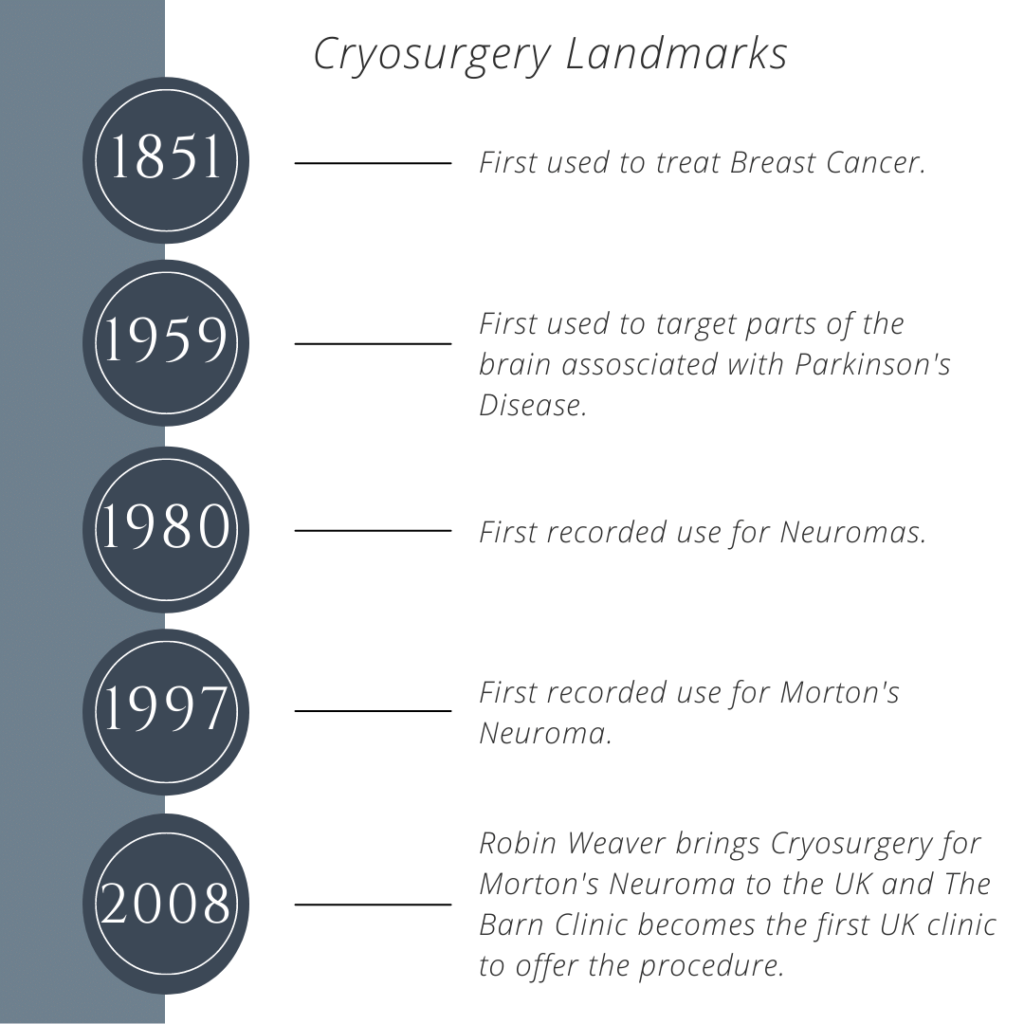
Cryosurgery for surgically induced neuromas has been performed from at least 1980 (1). Cryosurgery for Morton’s neuroma has been performed since the 1990’s and was first described in the medical literature in 1997 (2). However, cryosurgery has a rich medical heritage dating back to the beginning of the nineteenth century.
Cryosurgery in Medicine
Uses of Cryosurgery in modern medicine today include:
- Eye cancer
- Skin cancer
- Prostate cancer
- Liver cancer
- Bone cancer
- Lung cancer
Ongoing cryosurgery research includes:
- Oral cancer and conditions of the mouth that can turn into cancer
- Colon cancer
- Pancreatic cancer
- Kidney cancer
Cryosurgery for Cancer
In the early 19th century a British physician named James Arnott, working in Brighton, began using freezing techniques to treat breast cancer. In published reports between 1845 and 1851, he described the successful use of a solution of crushed ice and sodium chloride to not only reduce pain but freeze advanced cancers in the breast and the uterus (3).
In 2021, 170 years later, cryosurgery still has an important role in the treatment of breast cancer. Breast cancer patients whose lumps are first frozen with ultrasound guided cryosurgery prior to having the lump surgically removed have been shown to have much lower rates of the lump returning after surgery, with a return rate of 1.3% compared to a return rate of 9.2% for those that did not have the lump frozen first. Not only is the reoccurrence lower in the cryosurgery group, but the three-year survival rate is much higher at 85.7% compared to 65.0% for those that didn’t have cryosurgery as part of their treatment (4).
Cryosurgery is also used to treat non-cancerous benign breast lumps called fibroadenomas. Treated fibroadenomas following cryosurgery have been shown to shrink by 73–89%, with patients noting disappearance of the lump and good cosmetic appearance 12 months after the procedure (5).
What makes Cryosurgery such a good option for treating Morton’s Neuroma?
The qualities of cryosurgery that work well for breast lumps also lend themselves very well to the treatment of Morton’s neuroma. A Morton’s neuroma is a non-cancerous abnormality of the nerve sheath, where the sheath evolves after injury or compression to become a lump of abnormal tissue and cells. The abnormal cells of the sheath compress the central part of the nerve, called the axon, generating abnormal sensation and discomfort.
One of the features that makes cryosurgery such a good option for treating breast lumps and Morton’s neuroma is that the fact that unlike all other treatments, cryosurgery does not cause surgical scar tissue. This is because it does not adversely affect or damage collagen found in connective tissue. Studies that looked for scar tissue at 5 and 6 months following cryosurgery and excision breast lumps (involving Ultrasound imaging, mammography and MRI scanning) were all 100% negative for the presence of scar tissue. This is because collagen in connective tissue is not prone to scarring after cryosurgery.
The fact that collagen can withstand and survive being frozen is one of the reasons cryosurgery is used for treating skin cancers on and around the nose and eyes. This means the cancers can be eradicated with the cryosurgery without facial disfigurement caused by destruction of the surrounding collagen. Collagen is also found in the connective tissue of nerves including Morton’s neuroma. The fact that the collagen in the connective of the nerve (called the epineurium and endoneurium) can survive being frozen explains why the nerve is not destroyed following cryosurgery to a Morton’s neuroma.
A British physician and anaesthetist Benjamin Richardson introduced ether spray in 1866, which was replaced by the more effective ethyl chloride freezing spray in 1891, allowing a German surgeon called Freidrich Trendelenberg to freeze nerves as early as 1917. He demonstrated nerves can withstand being frozen. After Trendelenberg had frozen the nerve, he observed a temporary breakdown of the nerve and loss of function followed regeneration and restoration of function without neuroma formation (6).
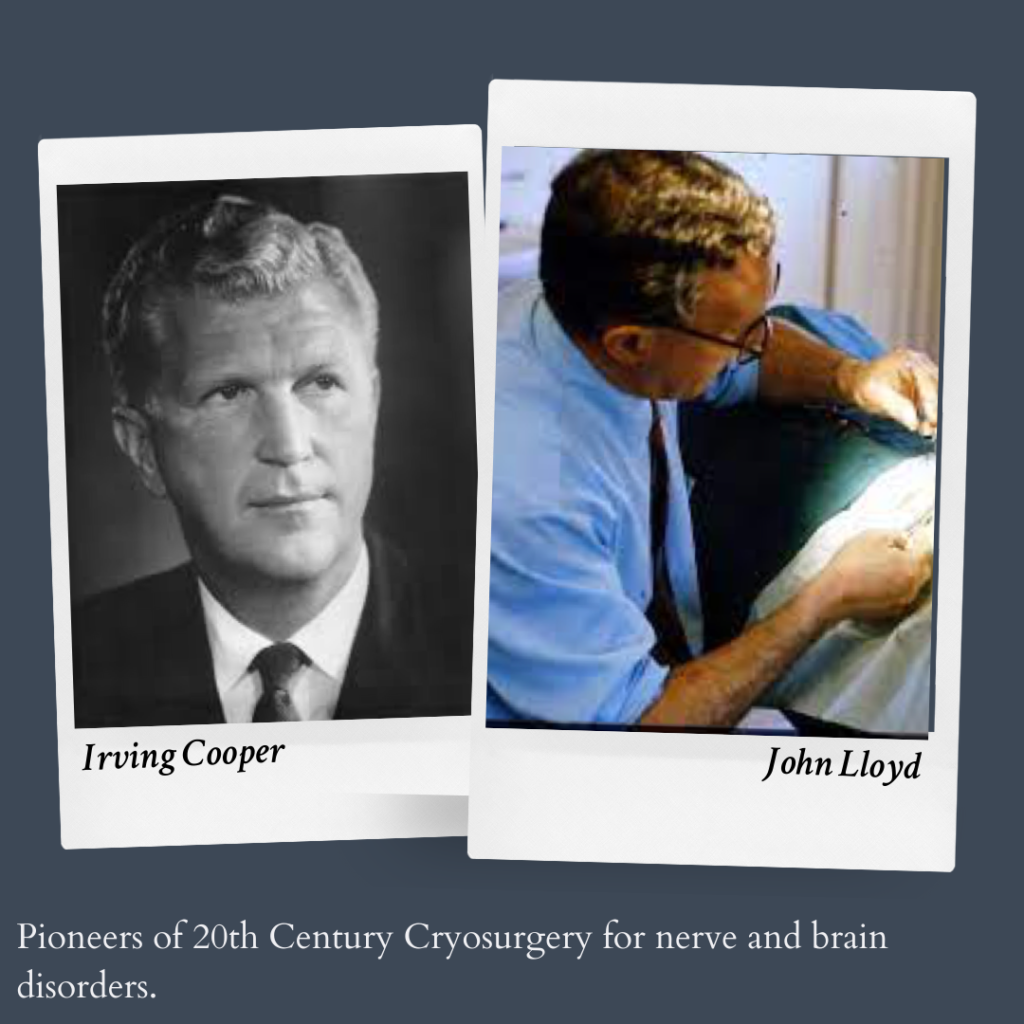
Modern cryosurgery equipment and techniques were developed between the 1950s and 1970’s by pioneers such as Dr John Lloyd in Oxford, UK and Irving Cooper, a founding father of modern neurosurgery based in New York. Irving Cooper developed the Modern cryoprobe (that is still used today for treating Morton’s neuroma) for treating parts of the brain that cause tremor in Parkinson’s disease.
Summary
After a nerve containing a neuroma has been frozen there is a breakdown of the nerve, including the fibrous inflammatory cells of the neuroma. When the nerve regenerates, it does so without the abnormal inflammatory cells that had previously caused the Morton’s neuroma.
In summary cryosurgery is the only treatment that can reverse nerve damage and restore normal function, with minimal risk of scar tissue formation.
References
1-Barnard D. The effects of extreme cold on sensory nerves. Ann R Coll Surg Engl. 1980 May;62(3):180-7. PMID: 7396346; PMCID: PMC2492372.
2-Lawrence Hodor; Kevin Barkal; Lisa D. Hatch-Fox (1997). Cryogenic denervation of the intermetatarsal space neuroma. , 36(4), 311–314. doi:10.1016/s1067-2516(97)80079-8
3-Arnott J. 1851. On the Treatment of Cancer by the Regulated Application of an Anesthetic Temperature. 32 pp.London: Churchill
4- Litvinenko O, Lyalkin S, Lavrik G. Results of cryosurgery
in the treatment of patients with breast carcinoma. Eur J Cancer 2005;3:436. Available online: http://www.ecco-org. eu/ecco_content/ECCO13_abstractbook/ les/assets/seo/ page152.html
5-Littrup PJ, Freeman-Gibb L, Andea A, et al. Cryotherapy for breast fibroadenomas. Radiology 2005; 234:63–72
6-Trendelenberg, W. Uber Landauende Nervenausschaltung mit siehe Regenerationsfahigkeit. Zeitschrift fur die gesamte experi- mentelle Medizin. 5:371-374, 1917.

Mr Weaver has a special clinical interest in podiatric regenerative medicine and was among the first clinicians in Europe—and the first in the UK—to offer cryosurgery (cryoablation) for Morton’s neuroma. Driven by a commitment to excellence in patient care, he focuses on delivering precise, evidence-based treatments that prioritise long-term recovery and patient comfort.
Over the past 18 years, he has performed approximately 20,000 procedures for Morton’s neuroma and bursitis. This extensive experience allows him to provide a highly personalised approach, ensuring every patient receives the specialist attention required for the best possible outcomes.
His professional memberships include the Institute of Podiatrists, the International Society of Cryosurgery, and the British Medical Ultrasound Society.