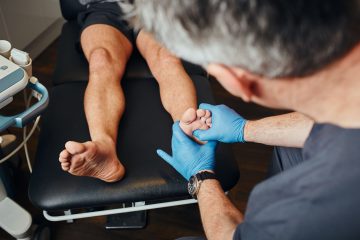
Morton's Neuroma diagnosis is typically made by listening to your symptoms and an examination of the affected foot.
Morton's Neuroma Diagnosis by Medical Imaging
Another form of diagnosis is the use medical imaging. Neuromas can be visualised on MRI and Ultrasound scans.
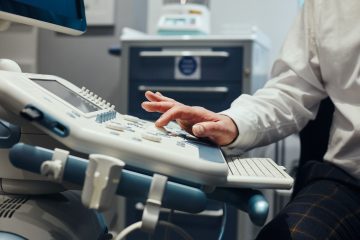
Here at The Barn Clinic, we prefer to use Ultrasound imaging, as we can scan, move and manipulate the foot in order to locate a neuroma. Sometimes when MRI is used, neuromas can occasionally be missed, as the scan rely in the foot being in a very precise position, and the patient remaining perfectly still. It is for this reason we carry out all our own medical imaging to locate, measure and diagnose Morton's neuroma.
Mulder's Click
One physical examination that is often carried out to diagnose a Morton’s neuroma, is something called a Mulder’s Sign or a Mulder’s click. This simple Morton's Neuroma test includes squeezing the metatarsals together with one hand in order to reproduce pain, or a click. A positive Mulder’s sign is indicative of the presence of a Morton's neuroma.
Tinel Sign
A shooting pain that is felt by the patient when the forefoot webspace is being directly compressed.
Gauthier's Test
This test is positive for the presence of a Morton's Neuroma if squeezing the metatarsals together, while simultaneously moving the toes up and down for 30 seconds reproduces the patients symptoms.
Sullivan's Sign
The toes appear to be spread apart when weight-bearing. This is caused by the presence of the neruoma in-between the metatarsals.
Contact Us
Morton's Neuroma Symptoms
Morton’s Neuroma Symptoms Morton's neuroma symptoms can vary widely amongst patients. Some patients describe shooting pains from the ball of the foot through the toes, while others...
Read MoreMorton’s Neuroma Treatment
There are a number of different Morton's Neuroma treatment options available, all with varying success rates. It can be confusing trying to determine which the best treatment...
Read MoreCryosurgery for Morton’s Neuroma
Cryosurgery is a modern form of treatment for Morton’s Neuroma, which offers patients a minimally invasive, clinic-based procedure with a high success rate and no risk of stump...
Read More