

Is it better to wait for Morton’s Neuroma to get worse before seeking treatment?
During the pandemic, like many others, I have been increasingly reflecting on my own personal quality of life re-prioritising what is and isn’t important, even more so since recently turning 50. During these reflections I have at times been quite touched and moved by accounts from my patients who have had to endure the dark hours of the pandemic with foot pain, often thinking they had nowhere to turn to, and that they should somehow have to put up with pain.
With that in mind I find myself writing todays blog at lunchtime, about why we sometimes we have to put up with pain, and sometimes not. Let me set the scene, today is a lovely Monday afternoon in London. Outside the temperature is a sweltering 28 degrees, the sun is shining, Scotland are about to play the Czech Republic in the Euros, The London Standard Headline is “Freedom Day pushed back 4 weeks due to the rise in delta variants”
So, with all of these heady events swirling around in my mind I have decided to address a common question that I regularly hear
Table of Contents
“Is it better to wait for the neuroma to get worse before seeking treatment?”
Let me start by stating the obvious: A Morton’s neuroma only needs treatment if it is giving discomfort or interfering with normal activities of day-to-day living. A Morton’s neuroma should not be treated simply because it is present. Occasionally, asymptomatic patients are told by professionals, by way of an examination process, that they have a neuroma. Such patients can understandably worry, and wonder if they should have it removed. For such patients the answer is no. It is estimated that just over half the population have a silent, asymptomatic Morton’s neuroma, they are a common finding when performing imaging and examining patients.
Such people report that their Morton’s neuroma doesn’t cause pain or discomfort, or interfere with activities of living, or otherwise prevent active and productive lives. These individuals simply don’t require treatment, and for most they are not likely to develop into a full-blown neuroma, especially if the foot is in the correct size shoe, and not in one or two sizes too small (the subject of a future blog methinks).
How about people with Morton’s neuroma symptoms?
For a condition that affects just over half the population without any symptoms, no one knows for sure how many people with Morton’s neuroma actually get symptoms. Best estimates suggest that somewhere between 90-100 people per 100,000 of the population suffer regular pain with their neuroma. Based on those estimates about nine and a half thousand people this afternoon in the city of London will be living with a neuroma, and possibly wondering about when and how to get it treated.
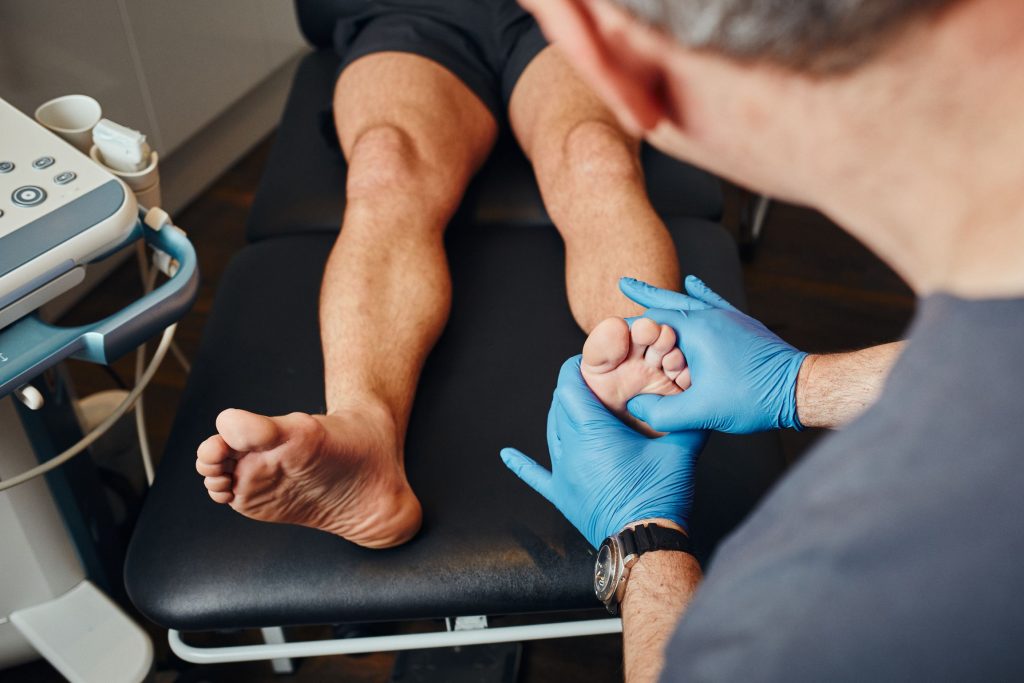
Should I wait for things to get worse?
The idea that someone should wait to have treatment for a neuroma is probably related to the fear of stump neuroma formation following excision surgery, and possibly experience of other conditions that require the condition to be as bad as the person can tolerate before surgery.
A good example of such a condition is joint replacement surgery. Replacement joints have a finite lifespan, typically a new knee joint will at best, last 20 years. A replacement of a replacement is far more complicated procedure and far more difficult than the original replacement, and generally best avoided. Meaning it’s often better to let someone get as long as they can out of their knee before having it replaced, as this minimizes the possibility of a re-do down the line. The downside to this approach is the pain and loss of quality of life experienced during the waiting period, which can sometimes many years.
The best example of someone having to wait for a condition to deteriorate was cataract eye surgery. Cataract eye surgery involves removing the cloudy stiff lenses in the eye, usually caused by age and UV light exposure. Such patients were historically told to wait for the cataract to get ‘ripe’ and for the lens to be as stiff as possible, patients were told this because it was much riskier to remove a softer lens than a stiff lens.
With improved treatment techniques that sometimes utilise ultrasound or a form of cryosurgery called cryoextraction, even soft lenses in much younger people can be frozen and safely removed. This advance in eye surgery means people no longer have to wait years with poor vision, they can seek treatment as soon symptoms dictate. Cryosurgery for Morton’s neuroma has had the same effect on Morton’s neuroma treatment that cryoextraction has had on cataract replacement. meaning younger people can have treatment that is both successful and safe.
Morton’s neuroma Excision surgery
Historically patients with Morton’s neuroma were told to wait as long as they could before considering surgery because outcomes following excision are uncertain and can include stump neuroma formation (sometimes referred to as amputation neuroma), where the remaining ends of the cut nerve become swollen and painful.
Cryosurgery has no risk of stump neuroma formation, (1,2,3,4,5,) meaning there is no need to wait before having treatment.
The benefits of Cryosurgery for Morton’s Neuroma:
Safety:
Cryosurgery is a safe procedure that does not carry the same types of risk as excision surgery. Cryosurgery removes the need for cutting of tissue. Instead cryosurgery delivers controlled damage or injury to the diseased section of nerve sheath, causing the diseased nerve tissue to breakdown and be reabsorbed. Following reabsorption, the nerve regenerates, typically without disease of the nerve sheath, gradually the nerve reverts back to normal and re-myelinates, restoring normal sensation to the forefoot. Our infection rates are year on year below 1%.
A smoother recovery
The recovery form cryosurgery does not require the use of strong pain killing medication. Patients are able to walk and fully weight-bear within 1-2 hours after treatment in their own shoes. Patients are able to drive within 3 days.
Long term results
The results from cryosurgery offers a long-term cure. We know that over a long-term period of 14-15 years relapse rates are very low.
Why doesn’t cryosurgery destroy the nerve?
Nerve injury is classified by severity of injury on a scale of 1-5, with 1 being the least and 5 being the most severe type of injury, 5, type 5 injuries are associated with permanent irreversible destruction of the nerve (6).
Cryosurgery treatment for Morton’s Neuroma is caused by using extreme cold temperatures and results in Class 2-3 damage. Class 3 damage is ‘reversible’ as ultimately the nerve reverts back to normal. This is because the basic connective tissue or ‘scaffolding’ of the nerve is still preserved allowing for ‘organised ‘repair of the nerve which recovers typically at a rate of 1mm per week (7).
From a cryosurgery perspective are there any there any benefits to treating a smaller neuroma?
Once a neuroma has become symptomatic it’s probably better get it treated sooner rather than later, to ‘nip it in the bud’ so to speak. This is because smaller neuromas are easier to treat and typically recover a lot faster than very large dense fibrous neuromas.
Finally, Good luck to all the home nations and Scotland this afternoon, Freedom-day will come soon, as will foot pain freedom-day!
The take home message:
During the last quarter of a century cryosurgery has proved to be both safe and effective treatment for Morton’s neuroma, with no cases reported worldwide of stump neuroma formation, there is now no need to wait for things to get to the point you can longer live with the pain from your neuroma.
Choose cryosurgery. Choose foot pain freedom.
References
- Amoils SP. The Joule Thomson cryoprobe. Arch Ophthalmol. 1967 Aug;78(2):201-7. doi: 10.1001/archopht.1967.00980030203014. PMID: 4952598.
- Evans PJ. Cryoanalgesia. The application of low temperatures to nerves to produce anaesthesia or analgesia. Anaesthesia. 1981 Nov;36(11):1003-13. doi: 10.1111/j.1365-2044.1981.tb08673.x. PMID: 7316118.
- Johnson JE, Johnson KA, Unni KK. Persistent pain after excision of an interdigital neuroma. Results of reoperation. J Bone Joint Surg Am. 1988 Jun;70(5):651-7. PMID: 3392057.
- Hodor L, Barkal K, Hatch-Fox LD. Cryogenic denervation of the intermetatarsal space neuroma. J Foot Ankle Surg. 1997 Jul-Aug;36(4):311-4. doi: 10.1016/s1067-2516(97)80079-8. PMID: 9298449.
- Myers RR, Powell HC, Heckman HM, Costello ML, Katz J. Biophysical and pathological effects of cryogenic nerve lesion. Ann Neurol. 1981 Nov;10(5):478-85. doi: 10.1002/ana.410100512. PMID: 7305300.
- Sunderland S. Nerve and nerve injuries. 2nd ed. New York: Churchill Livingstone; 1978).
- Hsu M, Stevenson FF. Wallerian degeneration and recovery of motor nerves after multiple focused cold therapies. Muscle Nerve. 2015;51(2):268-75).

Mr Weaver has a special clinical interest in podiatric regenerative medicine and was among the first clinicians in Europe—and the first in the UK—to offer cryosurgery (cryoablation) for Morton’s neuroma. Driven by a commitment to excellence in patient care, he focuses on delivering precise, evidence-based treatments that prioritise long-term recovery and patient comfort.
Over the past 18 years, he has performed approximately 20,000 procedures for Morton’s neuroma and bursitis. This extensive experience allows him to provide a highly personalised approach, ensuring every patient receives the specialist attention required for the best possible outcomes.
His professional memberships include the Institute of Podiatrists, the International Society of Cryosurgery, and the British Medical Ultrasound Society.