
A stump neuroma is a painful tangle of nerve endings that can form after a Morton’s neuroma has been surgically removed. For patients who feel they have run out of options, cryosurgery offers a minimally invasive way to bring the pain under control.
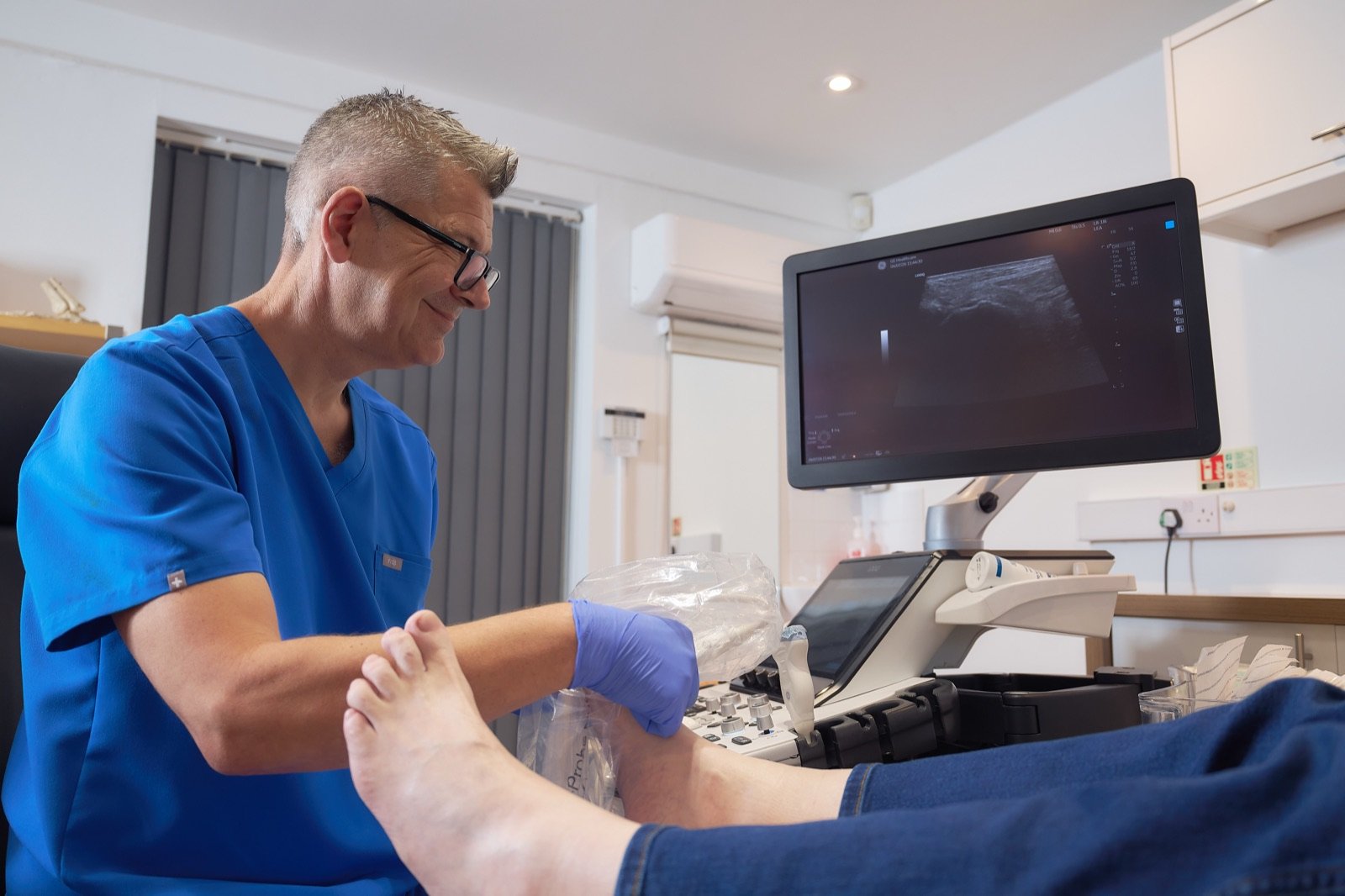
What Is a Stump Neuroma?
Surgery to remove a Morton’s neuroma — a neurectomy — involves cutting the nerve and taking out the affected section. That leaves two cut nerve endings behind, and at those endings the nerve fibres become disorganised and change shape, forming what is known as a stump.
Every cut nerve forms a stump. In fact, 100% of cut nerves form a stump neuroma — but that does not mean everyone has pain.
Around a third develop pain. Roughly 30–40% of patients who have a neurectomy go on to develop a painful stump neuroma. It can appear soon after surgery, or years later.
It will not settle on its own. Left untreated, a stump neuroma does not resolve by itself, and the pain tends to become chronic.
Stump neuroma · part 1
What Is a Stump Neuroma, and Why Does It Form?
What a stump neuroma is, why it forms after Morton's neuroma excision surgery, how often it becomes painful, and why it does not settle on its own.
- What a stump neuroma is. Traditional Morton's neuroma excision surgery (neurectomy) involves cutting and removing a section of the nerve. Where the nerve is cut, the two remaining nerve endings become disorganised, change shape, and form a tangled nerve ending known as a stump neuroma.
- Formed in every case, painful in some. Every cut nerve forms a stump neuroma, so the rate of formation is 100%. That is not the same as the rate of pain. Approximately 30% to 40% of neurectomy patients end up with a painful stump neuroma.
- Variable onset after surgery. Symptoms can develop rapidly after the original operation, or emerge years later.
- It does not resolve spontaneously. Without targeted treatment a symptomatic stump neuroma does not rectify itself, and the symptoms become chronic and persistent.
Read the full transcript
Hi, I'm Robin. It's the last day of my holiday, and I just thought I would take this opportunity to talk to you about stump neuromas — about what they are, why they're such a problem, and what we can do to actually help you and to treat them for you.
So, stump neuromas: what are they? They are a collection of tangled nerve endings that occur at the site of where the neuroma was previously removed from. Morton's neuroma excision surgery is called a neurectomy, and a neurectomy involves cutting the nerve. Where the nerve was cut and taken out, that leaves two remnants of the nerve, and at those terminal endings, the nerve fibres become disorganised, change shape, and become what's known as a stump.
If you look at the frequency of stump neuromas, the answer is a bit more nuanced than you would expect. The frequency of a stump neuroma is actually 100%. If you take a nerve and you cut it, 100% of cut nerves form stump neuromas. But that doesn't mean that 100% of people that have neurectomies actually have painful stump neuromas. It's about 30% to 40% of people that have neurectomies that end up with painful stump neuromas.
Stump neuromas can occur years later, but sometimes that can be quite quickly afterwards. Without treatment, the stump neuroma doesn't rectify itself, and the symptoms just become chronic and persistent.
Why Stump Neuromas Are So Hard to Treat
Patients with a stump neuroma are often poorly served by the options available to them. In practice they are usually offered either more surgery — with unpredictable results and the risk of simply forming another stump — or long-term nerve-pain medication such as gabapentin, pregabalin, amitriptyline or duloxetine. These drugs can help, but many people would rather not depend on them, and some carry side effects and can be difficult to stop. This is exactly the situation in which cryosurgery comes into its own: minimally invasive, and often effective where little else has worked.
Stump neuroma · part 2
Treatment Options, and What Our Own Study Found
Why conventional options serve stump neuroma patients poorly, how ultrasound-guided cryosurgery differs, and the six-month outcomes from our own consecutive patient series.
- The conventional options are limited. Patients with post-surgical stump neuromas are poorly served by existing options. Revision surgery carries unpredictable results, while neuropathic medications (gabapentin, pregabalin, amitriptyline, duloxetine) can cause side effects, dependency concerns, and difficulty coming off them.
- Ultrasound-guided cryosurgery as a minimally invasive alternative. Cryosurgery targets the painful nerve stump percutaneously under ultrasound guidance, without further surgical cutting.
- Our own six-month outcomes. In a consecutive cohort of 9 to 10 stump neuroma patients followed up at six months, average Visual Analogue Scale pain scores reduced from 7 out of 10 before treatment to 2 out of 10 afterwards. Approximately half the patients became completely pain-free, all patients recorded lower pain scores (with one non-responder moving from 8 out of 10 to 7), and no patients were made worse, with no complications.
- Consistent with the published literature. These findings align with independent published series reporting substantial pain reduction in refractory neuromas: von Falck, Örgel et al., CVIR 2022, and Friedman, Richman & Adler, J Ultrasound Med 2012. Both are small observational series; there are no randomised comparative trials in this area to date.
Read the full transcript
Stump neuroma patients are actually really quite badly served by the range of existing options. The options that they have are either more surgery — with unpredictable results and probably more of the same in terms of results — or management with drugs, such as gabapentin, pregabalin, amitriptyline, and duloxetine. These drugs can be very helpful for nerve pain, but a lot of patients don't want to be dependent on drugs, and some of these drugs do have side effects and can be quite difficult to come off.
What can be done about stump neuromas other than drugs and more surgery? Well, this is where cryosurgery comes into its own. It's minimally invasive, and it does seem to have a really positive effect on patients with stump neuromas.
Recently, we conducted a study within our clinic looking at patients that had stump neuromas. We took a group of 9 or 10 consecutive patients that had cryosurgery with us and followed those patients up. What we found was that their level of pain was approximately 7 out of 10 before their treatment — so their average pre-treatment Visual Analogue Score (VAS) was 7 out of 10. When we followed those patients up at 6 months after treatment, we found that that average score had reduced from 7 out of 10 down to 2 out of 10.
Approximately half the patients that had the treatment were pain-free, and all the patients actually had lower pain scores. There is a slight caveat to that: one patient out of the 10 didn't respond as well as everybody else. That one patient's pain score decreased from an 8 out of 10 to a 7, so it's arguable that that one patient was a non-responder. No patients were made worse, and there weren't any complications with that group of patients that I can think of.
Our findings were actually in keeping with other published evidence regarding the efficacy of cryosurgery for stump neuromas. I'm not actually aware of any other treatment that is as effective as cryosurgery for stump neuromas. So cryosurgery for stump neuroma patients, I think, is an excellent alternative.
Cryosurgery for Stump Neuroma: Our Results
In a recent review of our own patients, we looked at a group of nine consecutive patients treated with ultrasound-guided cryosurgery for a stump neuroma and followed them up at six months.
Pain scores roughly a third of their starting level. On average, pain fell from about 7 out of 10 before treatment to about 2 out of 10 at six months.
Half became pain-free. Around half of the patients were completely pain-free, and every patient had a lower pain score than before.
One partial responder. In the interest of a full picture, one patient improved only slightly, from 8 out of 10 to 7 — so cryosurgery does not help everyone to the same degree.
No complications. No patient was made worse, and there were no complications in the group.
Many of these patients had lived with pain for years — on average six years, and in one case nineteen — and had assumed nothing could be done. One patient whose pain had lasted around a decade, scoring 9 out of 10, was pain-free (0 out of 10) at six months.
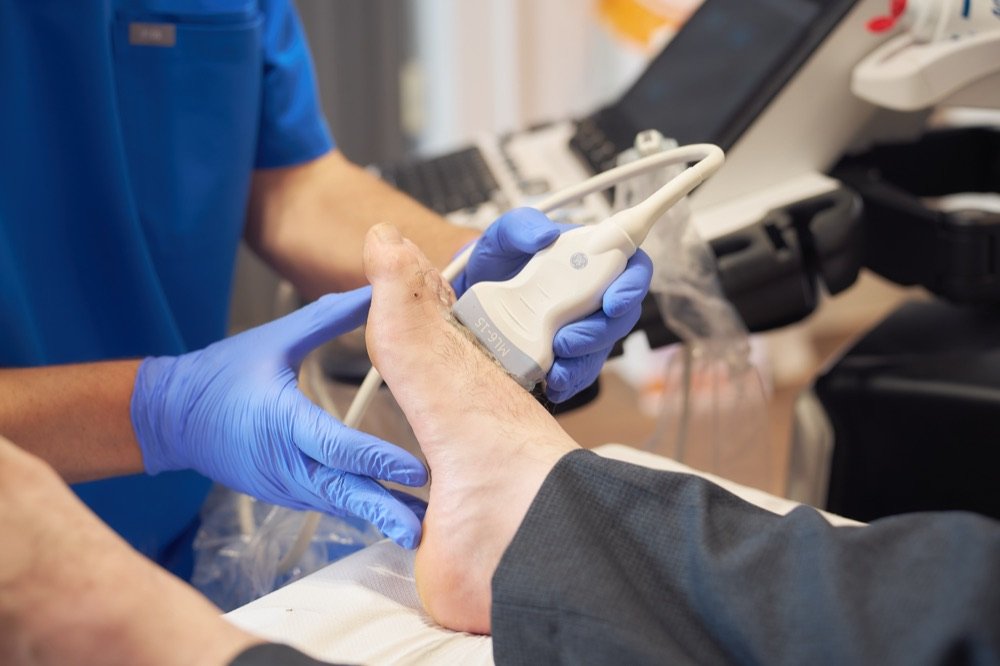
How Our Results Compare
Our findings are in keeping with the published evidence on cryosurgery for stump and peripheral neuromas. An independent series by von Falck and colleagues (CVIR, 2022) reported pain falling from a mean of 8.3 out of 10 before treatment to 2.1 at one week and around 3.0 at a mean of 27 months. A further series by Friedman and colleagues (Journal of Ultrasound in Medicine, 2012) found 15 of 20 patients responded positively. The full studies behind our approach are available on request.
How Cryosurgery Works on a Stump Neuroma
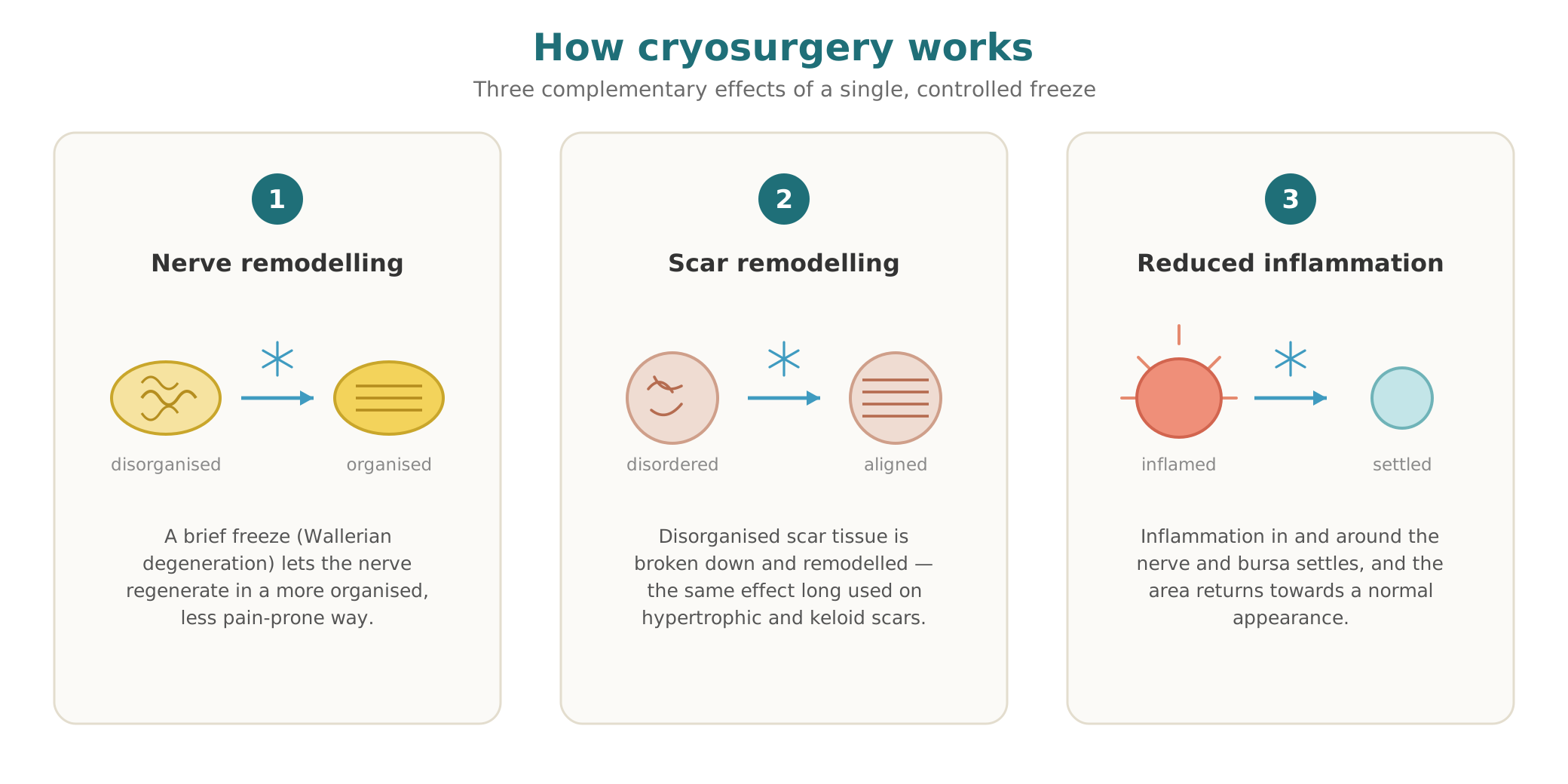
Cryosurgery appears to work in three complementary ways. It remodels the nerve: a brief, controlled freeze triggers a natural process called Wallerian degeneration, after which the nerve regenerates in a more organised, less pain-prone way. It remodels scar tissue: cryosurgery has long been used to treat hypertrophic and keloid scars, and a stump neuroma contains a great deal of similar internal scarring that responds to the same effect. And it calms inflammation: stump neuromas frequently sit alongside an inflamed bursa, and that settles at the same time, which only helps.
Stump neuroma · part 3
How Cryosurgery Works, and Outcomes After Years of Pain
The mechanism behind cryosurgery for stump neuroma — nerve remodelling, scar remodelling and reduced inflammation — and what it can achieve for people who have been in pain for years.
- Neural remodelling (Wallerian degeneration). Freezing the nerve stump causes a localised, temporary breakdown of the disorganised nerve endings, known as Wallerian degeneration, allowing the nerve to regenerate in a more sympathetic, less pain-sensitive manner.
- Internal scar remodelling. Post-surgical stump neuromas form internal hypertrophic scar tissue. Intralesional cryosurgery is a recognised treatment for remodelling hypertrophic and keloid scars — Har-Shai, Amar & Sabo, Plast Reconstr Surg 2003, reported a mean 51% reduction in scar volume after a single session, with histology showing more organised collagen architecture — softening internal scarring around the nerve.
- Resolution of co-existing bursitis. Patients with stump neuromas frequently have a secondary inflamed fluid-filled bursa sitting next to the nerve stump; cryosurgery dampens local inflammation so the co-existing bursitis improves simultaneously.
- Meaningful salvage even after years of chronic pain. In our clinical cohort the average duration of symptoms prior to cryosurgery was 6 years, ranging from 2 to 19 years, including a patient with 9 to 10 years of severe pain whose VAS score reduced from 9 out of 10 down to 0 at six months.
Read the full transcript
How does it work? Cryosurgery does seem to have a remodelling effect. First of all, it remodels the nerve, so it causes a localised, temporary breakdown of the nerve. This breakdown is referred to as Wallerian degeneration. Very quickly after the nerve has been frozen, you get a breakdown of the nerve, and the nerve regenerates. When it regenerates in stump neuroma patients, it seems to regenerate in a more sympathetic manner that's less prone to becoming painful. So it helps remodel the nerve.
Secondly, cryosurgery is a recognised treatment for treating scarring. Hypertrophic scars and keloid scars in the past have been treated with cryosurgery quite successfully, and there's a large element of that with stump neuromas: you see these hypertrophic scars that form internally. So the cryosurgery works by remodelling that scar tissue.
Also, as I've talked about in the past, it dampens down all the inflammation that you see in and around the nerve. Frequently, patients with stump neuromas have co-existing bursitis, where there's an inflamed sac of fluid that sits next to the stump neuroma. Simultaneously, that improves as well, which only helps the situation.
If you're one of those patients that think all is lost and that you've got no hope for the future, that isn't the case at all. Cryosurgery offers an excellent means of salvaging the situation. And that's actually what cryosurgery is referred to: it's referred to as a salvage treatment for such patients. It can be really meaningful.
Amongst that group of patients that I told you about, the average duration of symptoms was 6 years. Some patients had only been struggling for as little as 2 years, and one patient had had issues for 19 years. These patients with stump neuromas frequently think that they've actually got no hope, and life will just continue as they are, taking medications, et cetera. But that isn't the case — cryosurgery can offer a very meaningful resolution to this problem.
I can think of one patient in the group: he had had a lot of pain, and his pre-treatment pain score was a 9 out of 10. He had had symptoms for about 9 or 10 years prior to his cryosurgery. He went from a 9 out of 10 down to a 0 at 6 months. So you can imagine, that was life-changing, and they're the kind of results that can be achieved — not for everybody, I wish it could — but if it doesn't totally get rid of the pain, it's likely to improve it quite significantly for you.
A Salvage Treatment Worth Considering
Cryosurgery is often described as a salvage treatment — a way of rescuing a situation that has felt hopeless. If you are living with pain after Morton’s neuroma surgery and have been told there is nothing more to be done, that is very often not the case. It will not cure everyone, but for many patients it offers meaningful, lasting relief.
Contact Us for More Information
Mr Weaver sees patients at The Barn Clinic in Harley Street, London, and in Sheffield. Contact us or request an information pack to find out whether cryosurgery could help you.