
A stump neuroma is a painful tangle of nerve endings that can form after a Morton’s neuroma has been surgically removed. For patients who feel they have run out of options, cryosurgery offers a minimally invasive way to bring the pain under control.
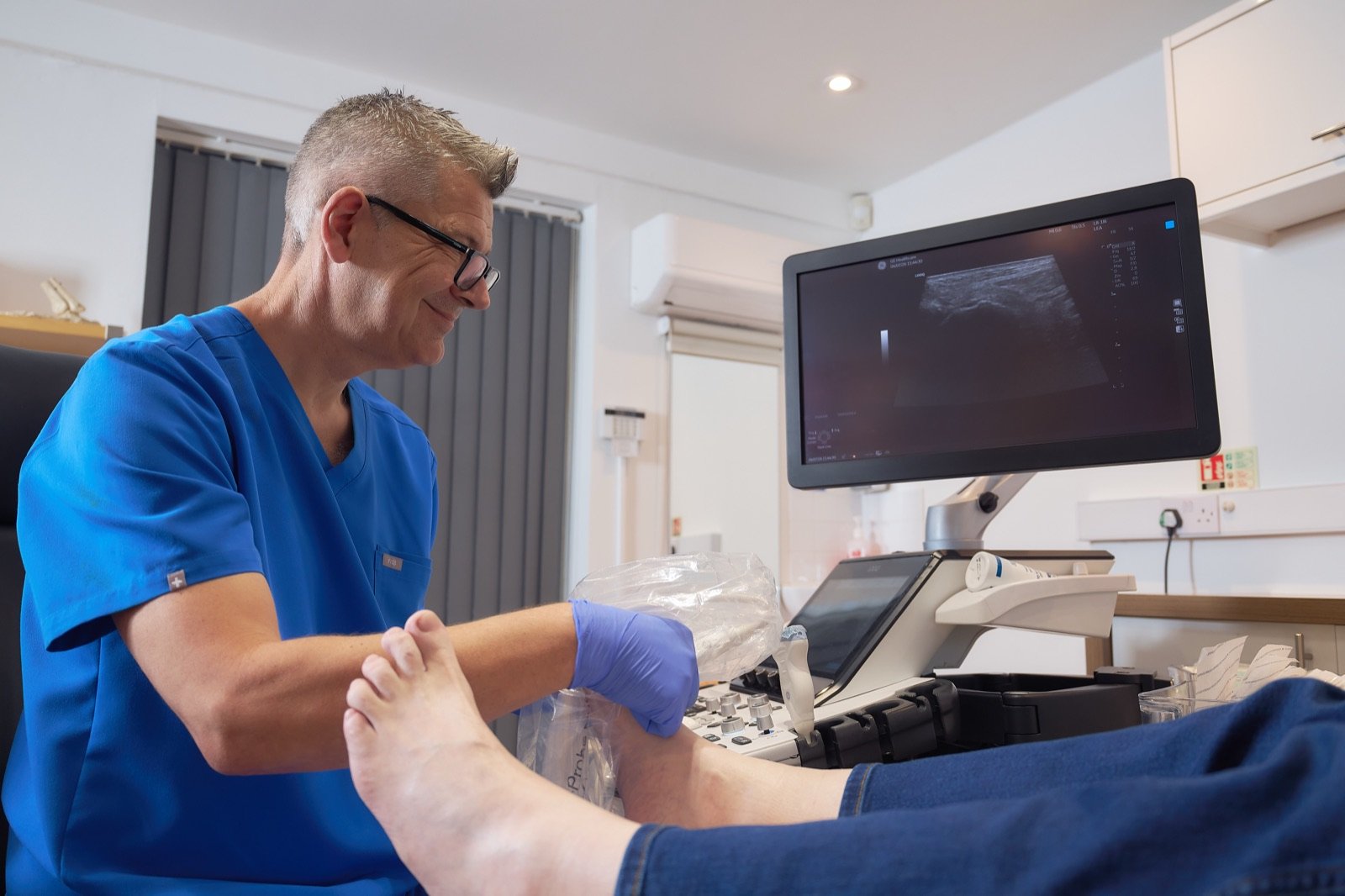
What Is a Stump Neuroma?
Surgery to remove a Morton’s neuroma — a neurectomy — involves cutting the nerve and taking out the affected section. That leaves two cut nerve endings behind, and at those endings the nerve fibres become disorganised and change shape, forming what is known as a stump.
Every cut nerve forms a stump. In fact, 100% of cut nerves form a stump neuroma — but that does not mean everyone has pain.
Around a third develop pain. Roughly 30–40% of patients who have a neurectomy go on to develop a painful stump neuroma. It can appear soon after surgery, or years later.
It will not settle on its own. Left untreated, a stump neuroma does not resolve by itself, and the pain tends to become chronic.
Stump neuroma · part 1
What Is a Stump Neuroma, and Why Does It Form?
What a stump neuroma is, why it forms after Morton's neuroma excision surgery, how often it becomes painful, and why it does not settle on its own.
- What a stump neuroma is. Traditional Morton's neuroma excision surgery (neurectomy) involves cutting and removing a section of the nerve. Where the nerve is cut, the two remaining nerve endings become disorganised, change shape, and form a tangled nerve ending known as a stump neuroma.
- Formed in every case, painful in some. Every cut nerve forms a stump neuroma, so the rate of formation is 100%. That is not the same as the rate of pain. Approximately 30% to 40% of neurectomy patients end up with a painful stump neuroma.
- Variable onset after surgery. Symptoms can develop rapidly after the original operation, or emerge years later.
- It does not resolve spontaneously. Without targeted treatment a symptomatic stump neuroma does not rectify itself, and the symptoms become chronic and persistent.
Read the full transcript
Hi, I'm Robin. It's the last day of my holiday, and I just thought I would take this opportunity to talk to you about stump neuromas — about what they are, why they're such a problem, and what we can do to actually help you and to treat them for you.
So, stump neuromas: what are they? They are a collection of tangled nerve endings that occur at the site of where the neuroma was previously removed from. Morton's neuroma excision surgery is called a neurectomy, and a neurectomy involves cutting the nerve. Where the nerve was cut and taken out, that leaves two remnants of the nerve, and at those terminal endings, the nerve fibres become disorganised, change shape, and become what's known as a stump.
If you look at the frequency of stump neuromas, the answer is a bit more nuanced than you would expect. The frequency of a stump neuroma is actually 100%. If you take a nerve and you cut it, 100% of cut nerves form stump neuromas. But that doesn't mean that 100% of people that have neurectomies actually have painful stump neuromas. It's about 30% to 40% of people that have neurectomies that end up with painful stump neuromas.
Stump neuromas can occur years later, but sometimes that can be quite quickly afterwards. Without treatment, the stump neuroma doesn't rectify itself, and the symptoms just become chronic and persistent.
Why Stump Neuromas Are So Hard to Treat
Patients with a stump neuroma are often poorly served by the options available to them. In practice they are usually offered either more surgery — with unpredictable results and the risk of simply forming another stump — or long-term nerve-pain medication such as gabapentin, pregabalin, amitriptyline or duloxetine. These drugs can help, but many people would rather not depend on them, and some carry side effects and can be difficult to stop. This is exactly the situation in which cryosurgery comes into its own: minimally invasive, and often effective where little else has worked.
Stump neuroma · part 2
Treatment Options for Stump Neuroma
Why conventional options serve stump neuroma patients poorly, and how ultrasound-guided cryosurgery differs.
- The conventional options are limited. Patients with post-surgical stump neuromas are poorly served by existing options. Revision surgery carries unpredictable results, while neuropathic medications (gabapentin, pregabalin, amitriptyline, duloxetine) can cause side effects, dependency concerns, and difficulty coming off them.
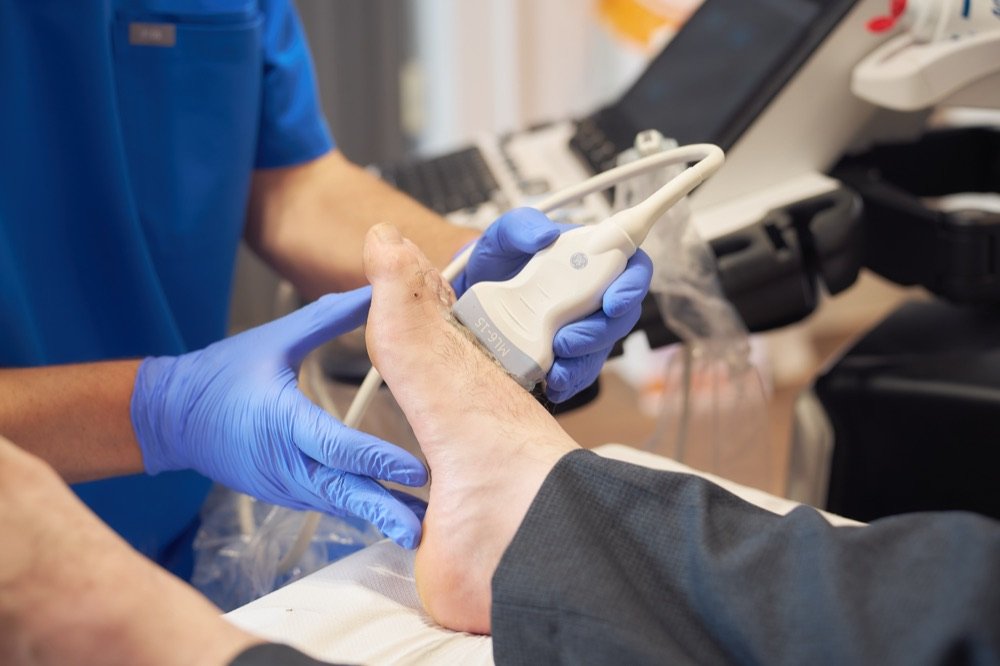
- Ultrasound-guided cryosurgery as a minimally invasive alternative. Cryosurgery targets the painful nerve stump percutaneously under ultrasound guidance, without further surgical cutting.
- Published literature. Independent published series report substantial pain reduction in refractory neuromas: von Falck, Örgel et al., CVIR 2022, and Friedman, Richman & Adler, J Ultrasound Med 2012. Both are small observational series; there are no randomised comparative trials in this area to date.
How Cryosurgery Works on a Stump Neuroma
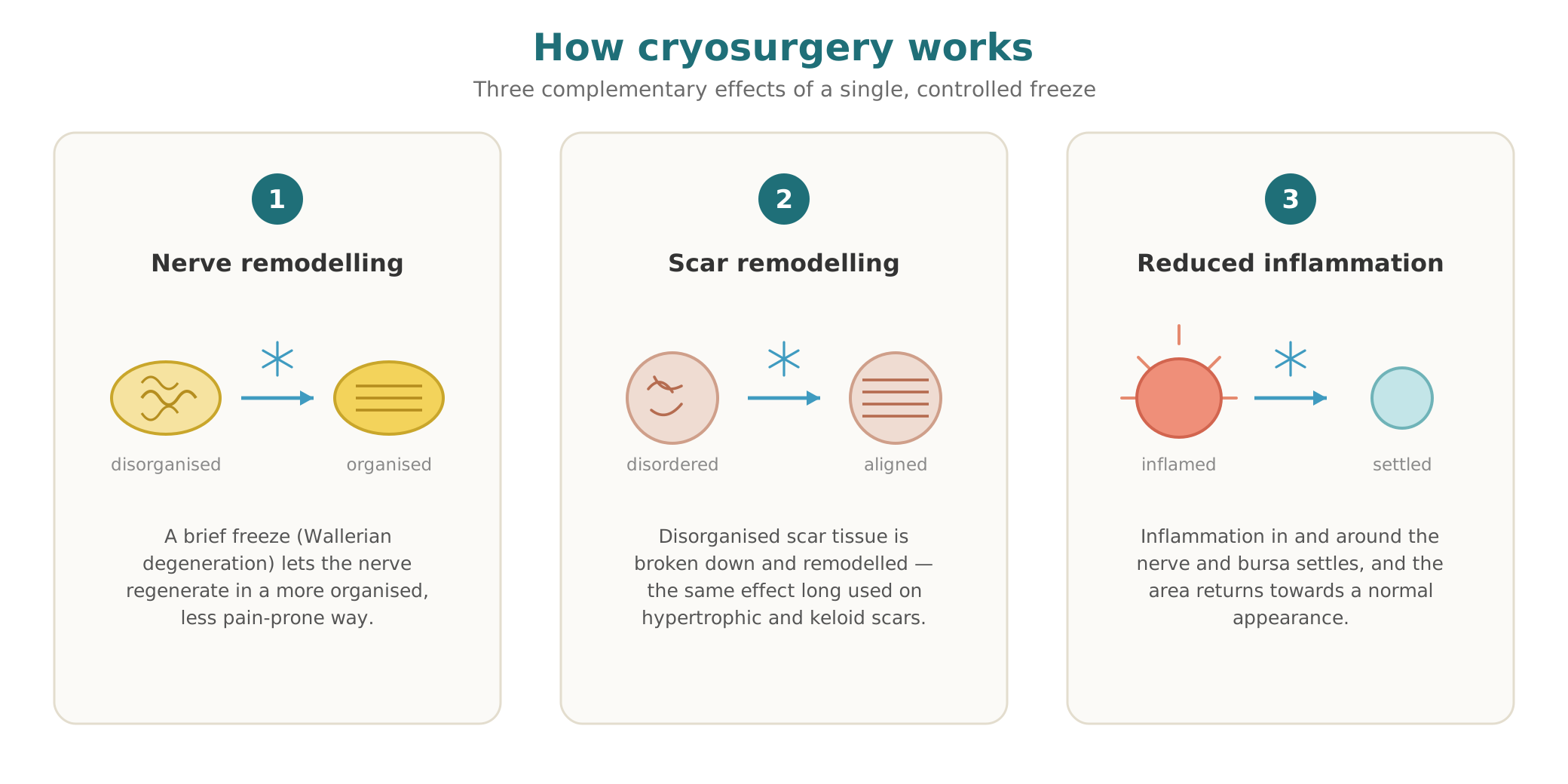
Cryosurgery appears to work in three complementary ways. It remodels the nerve: a brief, controlled freeze triggers a natural process called Wallerian degeneration, after which the nerve regenerates in a more organised, less pain-prone way. It remodels scar tissue: cryosurgery has long been used to treat hypertrophic and keloid scars, and a stump neuroma contains a great deal of similar internal scarring that responds to the same effect. And it calms inflammation: stump neuromas frequently sit alongside an inflamed bursa, and that settles at the same time, which only helps.
Stump neuroma · part 3
How Cryosurgery Works
The mechanism behind cryosurgery for stump neuroma — nerve remodelling, scar remodelling and reduced inflammation — and what it can achieve for people who have been in pain for years.
- Neural remodelling (Wallerian degeneration). Freezing the nerve stump causes a localised, temporary breakdown of the disorganised nerve endings, known as Wallerian degeneration, allowing the nerve to regenerate in a more sympathetic, less pain-sensitive manner.
- Internal scar remodelling. Post-surgical stump neuromas form internal hypertrophic scar tissue. Intralesional cryosurgery is a recognised treatment for remodelling hypertrophic and keloid scars — Har-Shai, Amar & Sabo, Plast Reconstr Surg 2003, reported a mean 51% reduction in scar volume after a single session, with histology showing more organised collagen architecture — softening internal scarring around the nerve.
- Resolution of co-existing bursitis. Patients with stump neuromas frequently have a secondary inflamed fluid-filled bursa sitting next to the nerve stump; cryosurgery dampens local inflammation so the co-existing bursitis improves simultaneously.
- Worth assessing even after years of pain. Stump neuromas are often a long-standing problem, and a long history of symptoms does not rule out assessment and treatment.
A Salvage Treatment Worth Considering
Cryosurgery is often described as a salvage treatment — a way of rescuing a situation that has felt hopeless. If you are living with pain after Morton’s neuroma surgery and have been told there is nothing more to be done, that is very often not the case. It will not cure everyone, but for many patients it offers meaningful, lasting relief.
Contact Us for More Information
Mr Weaver sees patients at The Barn Clinic in Harley Street, London, and in Sheffield. Contact us or request an information pack to find out whether cryosurgery could help you.