
Zero-Drop Shoes for Forefoot Pain: A Podiatrist’s Honest Take (and What I Actually Wear)
Table of Contents
Why this matters to me (before we talk science)
I’ll be honest from the outset: I’m a fan of zero-drop shoes. Not because a shoe company pays me — they don’t — but because of what happened to my own feet.
A few years ago, alongside a bout of COVID-19, I developed intermetatarsal bursitis. If you have ever had it, you’ll know the feeling: a burning, bruised, “pebble-under-the-foot” sensation that is almost indistinguishable from a Morton’s neuroma. I switched to cushioned, zero-drop Altra shoes at that point, and my symptoms settled almost immediately. That got my attention.
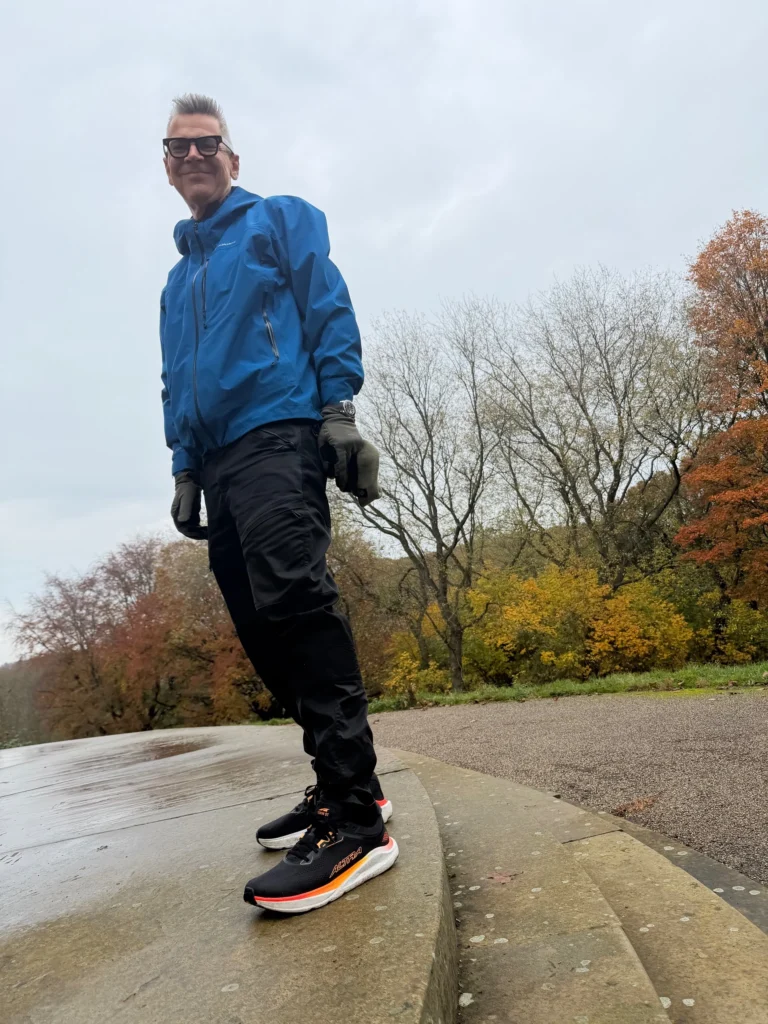
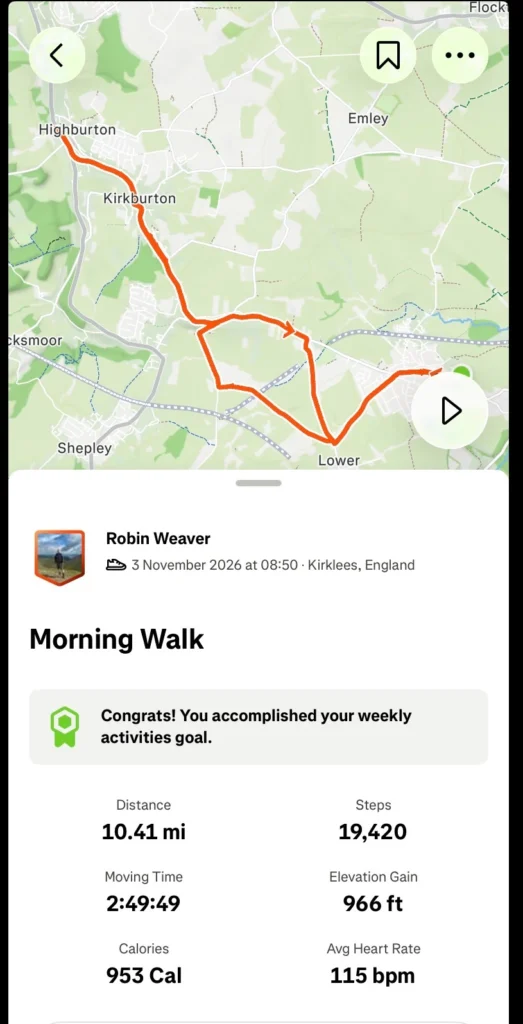
Walking is a huge part of my life. I love getting out across the Yorkshire countryside, and I’m convinced it is every bit as good for the mind as it is for the body. These days I wear Altras on the roads and paths, and Lone Peak boots on the hills. I now think nothing of ten miles at a brisk pace two or three times a week around home — the sort of Yorkshire route with close to a thousand feet of climb in it. Before the switch, that exact outing would have left my forefoot throbbing for days. Now, it simply doesn’t complain.
That is a personal story, not a clinical trial, and I’ll keep the two separate below. But it is why I talk about this every day with patients who just want to get their miles back.
First: clear up the biggest myth about “zero drop”
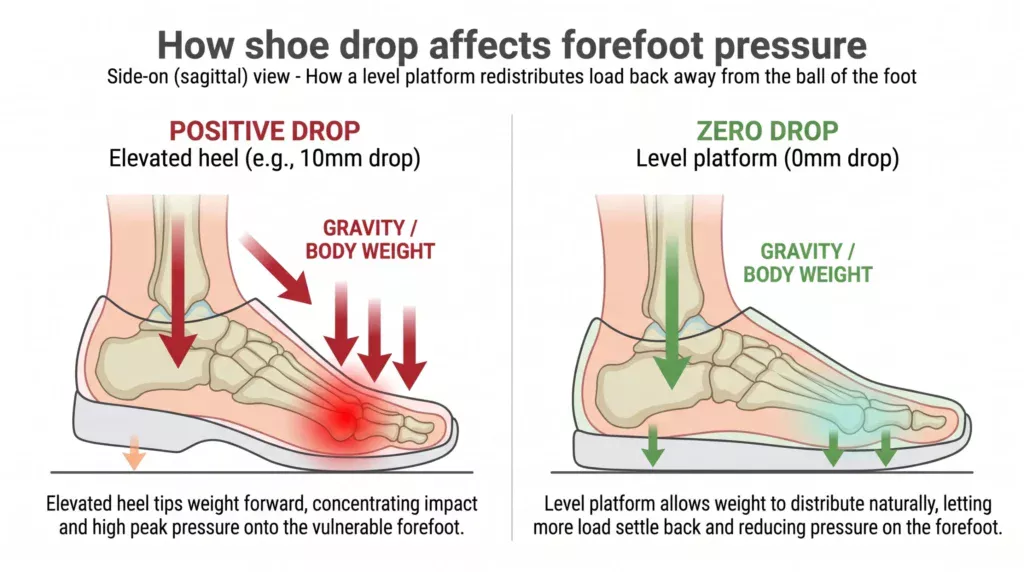
Every shoe has a drop — the height difference between the heel and the ball of the foot. A standard running trainer or everyday smart shoe raises your heel by 8 to 12 mm. A zero-drop shoe sits completely level: heel and forefoot are the same height off the ground, just as they are when you stand barefoot.
Here is the single most important thing to understand: zero drop is not the same as “barefoot” or “minimalist.”
- Drop is the angle of the platform (tilted down toward the toes vs level).
- Cushioning is how much material sits under your foot (thick shock-absorbing foam vs wafer-thin rubber).
You can mix and match the two. A zero-drop shoe can be thickly cushioned (like my Altras) or wafer-thin (like true barefoot shoes). If the ball of your foot is already sore, that distinction is everything.
Why a level, foot-shaped shoe works: the “Forefoot Triad”
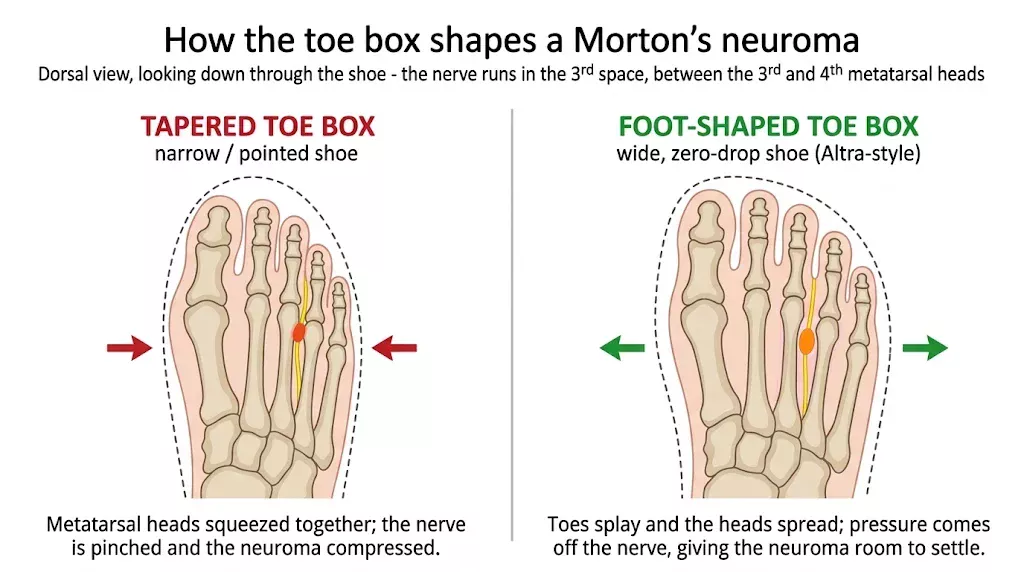
Two things irritate a vulnerable forefoot — whether you are dealing with Morton’s neuroma, intermetatarsal bursitis, or bunions: sideways squeezing and downward overload. A well-chosen zero-drop shoe addresses this through three simple mechanics.
1. Width: stop the sideways squeeze
Conventional trainers and fashion shoes taper inward at the toes, acting like a funnel. That squeezes the metatarsal heads (the knuckle bones of the forefoot) together, pinching the small plantar nerves and bursae that sit between them. Zero-drop brands almost always pair their flat platform with a wide, foot-shaped toe box — letting your toes splay naturally and giving an irritated nerve room to breathe.
2. Level platform: stop the forward slide
Raise the heel, and gravity tips more of your body weight down the slope onto the ball of the foot. Level the platform, and a meaningful share of that load settles back toward the midfoot and heel, which are built to carry it.
3. Cushioning & toe spring: stop the pound and the pull
A generous layer of foam protects the plantar nerves from sharp stones, tree roots, and hard pavements. Better still, many cushioned zero-drop shoes include a gentle toe spring — a slight upward curve (“rocker”) at the front of the sole. Biomechanically, that rocker rolls the foot through push-off so your toe joints don’t have to bend back as far, reducing the mechanical tug on the nerve and bursa underneath.
Why foot size and high heels change the maths
There is a geometric catch with shoe drop that rarely gets mentioned: drop is measured in millimetres, but your foot feels it as an angle.
A 10 mm heel lift spread across a long size 11 foot is a gentle slope. That exact same 10 mm lift across a shorter size 4 foot creates a significantly steeper ramp — tipping proportionally more body weight onto a smaller forefoot.
High heels take that geometry to its extreme. Research shows that as heel height rises, peak pressure under the forefoot climbs sharply and shifts directly over the metatarsal heads — the exact zone where metatarsalgia and Morton’s neuroma develop (Mandato & Nester, 1999; Ko et al., 2009). One of those studies suggests keeping heel height under 2 cm with forefoot padding to limit the damage. Zero drop simply travels to the safest end of that spectrum.
Debunking the barefoot hype: why thin soles backfire on sore feet
I am just as sceptical of barefoot zealots as I am of narrow fashion shoes. In 2014, Vibram — maker of the FiveFingers “toe shoes” — had to pay up to $3.75 million to settle a class-action lawsuit because it couldn’t scientifically back up claims that its shoes strengthened muscles and prevented injury.
Even worse is the internet myth that barefoot shoes “reduce forefoot pressure by 20–30%”. For thin-soled minimalist shoes, published research shows the exact opposite:
- Minimalist shoes increase forefoot pressure: when researchers measured in-shoe pressures in runners, thin minimalist shoes increased peak pressure by 13% under the inner forefoot and by nearly 38% under the central and outer forefoot compared with standard cushioned trainers (Bergstra et al., 2015). Less foam underfoot means more raw force hitting the ball of the foot.
- Switching to thin soles too fast causes injury: studies consistently show that minimalist shoes increase impact loading rates (Willson et al., 2014; Warne et al., 2017), and runners who transition abruptly risk Achilles tendinopathy and metatarsal stress fractures (Cauthon et al., 2013).
- Cushioning + width is what actually offloads the nerve: pressure comes down when a cushioned sole absorbs impact from below and a wide toe box spreads the load across the whole forefoot rather than focusing it on two pinched bones (Park & Chang, 2019).
The “hard kitchen floor” trap: for the exact same reason, if you have an active Morton’s neuroma or bursitis, avoid walking barefoot on hard kitchen tiles or wooden floors at home. Stepping onto hard indoor floors with zero cushioning underfoot irritates the nerve just like a wafer-thin shoe does. Keep a pair of cushioned, wide-fitting sliders or indoor trainers by the door.
The secret bonus: every step stretches your calves
If you have worn heeled shoes your whole life, your calf muscles and Achilles tendon have quietly shortened to match that 8–12 mm lift. Drop the heel to level, and you ask them to work through a slightly longer range.
When I first wore my Altras, I felt a distinct — though completely painless — pull in my calves for the first week or two before they settled. Beyond simply getting used to the shoes, that gentle stretch has a massive clinical upside:
- Tight calves are a hidden driver of forefoot pain: when your calf and Achilles are tight, your ankle cannot bend forward as freely during your stride. As a result, your heel lifts off the ground early, throwing extra weight onto the ball of your foot for longer on every single step.
- Calf stretching is a frontline treatment in its own right: we prescribe daily calf stretches for Morton’s neuroma, bursitis, and metatarsalgia because freeing up the ankle takes load off the forefoot.
- Zero-drop shoes do that stretching work for you all day long, gently lengthening the calf with every stride.
How to transition safely (without annoying your calves)
- Week 1: wear your new zero-drop shoes for short 20- to 30-minute walks or around the house, alternating with your old shoes.
- Week 2: build up to 45- to 60-minute walks every other day. Expect a mild awareness in your calves, never sharp pain.
- Week 3 onwards: gradually phase them in as your main walking shoe once your calves feel completely normal.
- Check your socks and bottom laces: a wide toe box is wasted if you wear tight elastic socks that bind your toes together, or if you pull the bottom two eyelets of your laces tight. Leave the front of the lacing loose (or skip the bottom eyelet entirely) so the shoe can actually expand.
Cushioned or minimal? My honest preference (and the insole trick)
Here is where I come off the fence: for clinical protection as much as comfort, I favour cushioned zero-drop shoes. Here is how the two pairs in my own hallway compare.
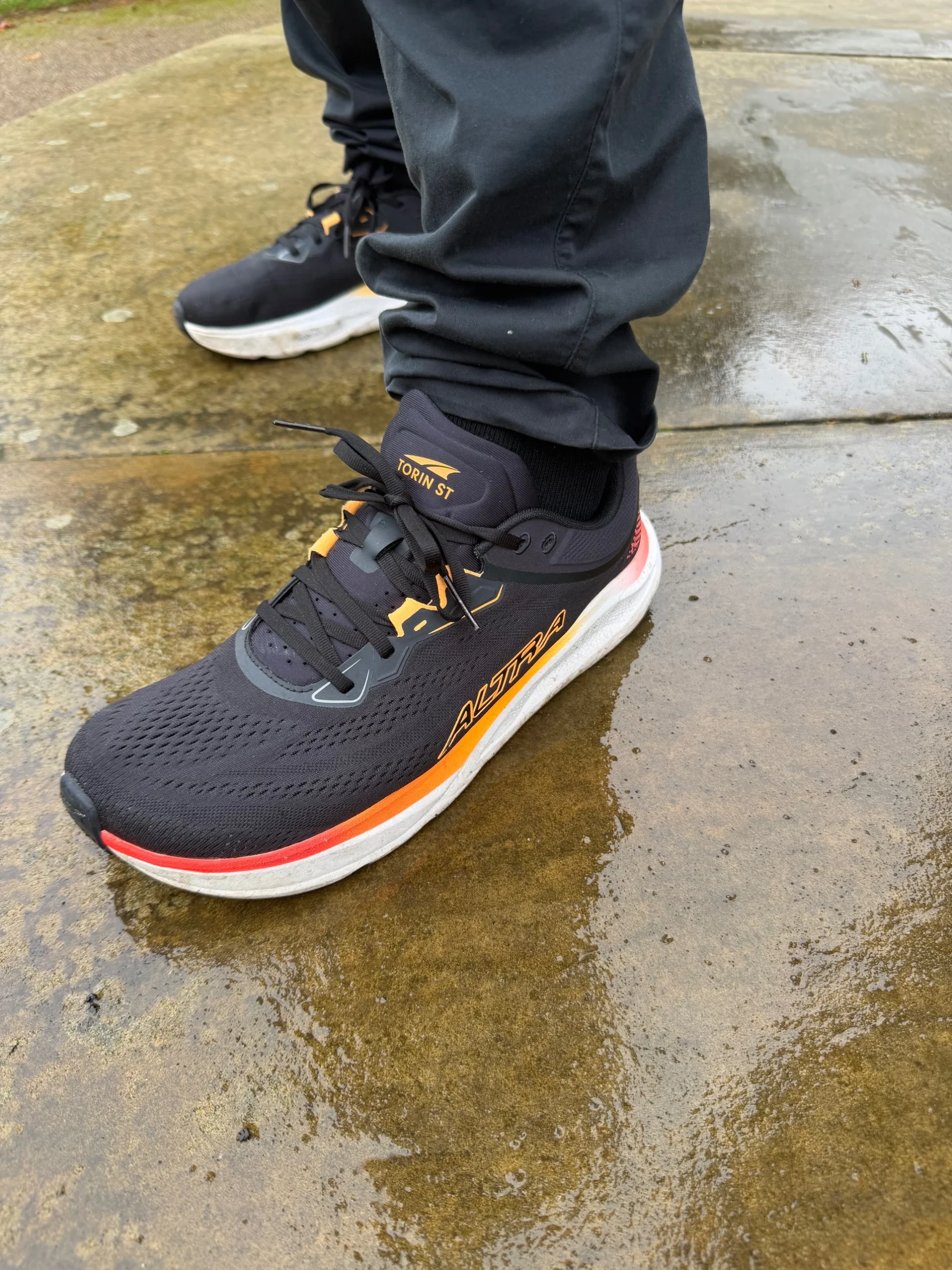
My workhorse for distance — Altra Torin ST
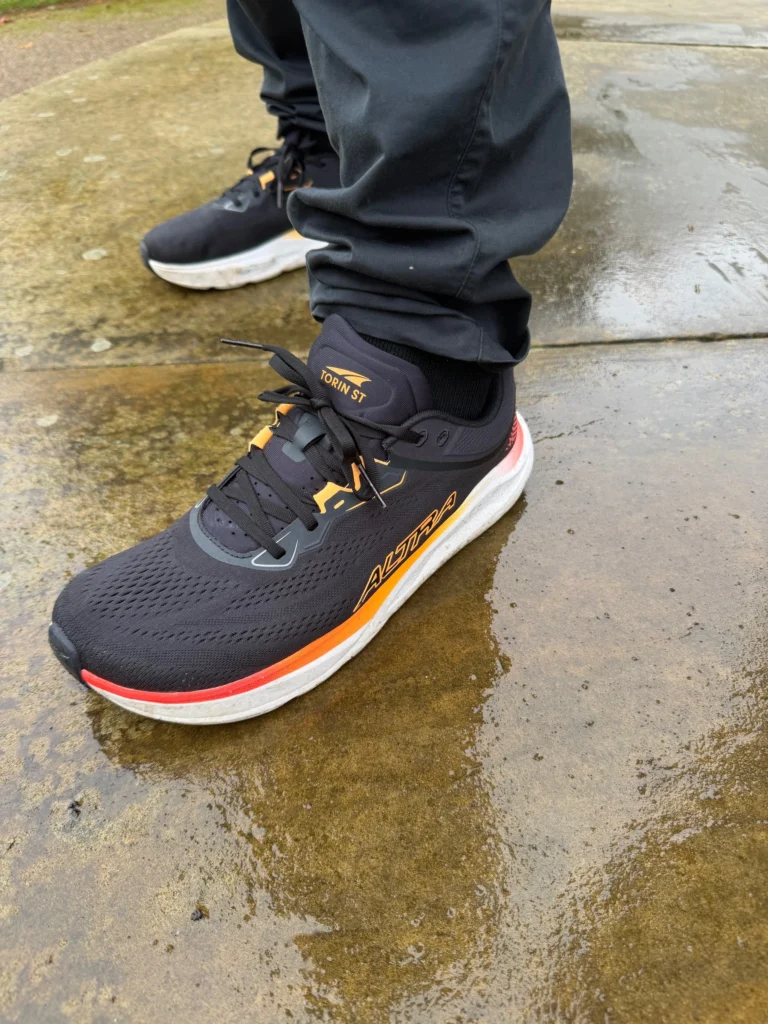
- The feel: zero drop, wide foot-shaped toe box, thick protective cushioning, and a gentle front toe spring that smooths out push-off.
- Why the “ST” model: I ran in Altra Paradigm 5s for years. Now they are discontinued, the Torin ST — Altra’s stability version with subtle medial support — is the closest match.
- The verdict: once your calves adapt, they feel unremarkable in the best possible sense — a super-comfortable shoe that lets you cover ten hilly miles without a second thought.
My slimmer everyday hack — minimal Topo + insole
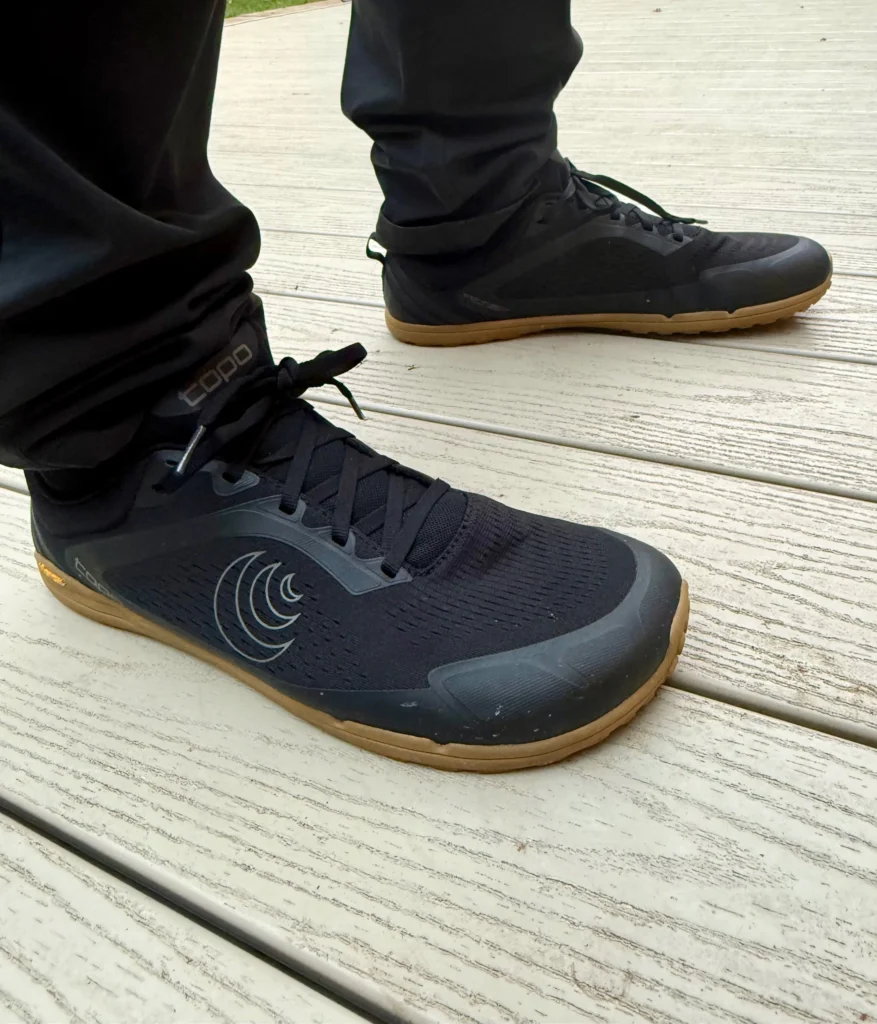
- The problem: out of the box, this pair is from Topo Athletic’s ultra-thin minimal line with no toe spring, and I felt oddly heavy-footed, conscious of every stone and ridge — far too thin to protect the plantar nerves over distance.
- The insole trick: I slipped in a modest, inexpensive cushioned insole. That gave me Altra-like comfort in a sleek, low-profile shoe without the chunky “trainer-on-stilts” look. (Domestic confession: my wife, who is far more fashion-conscious than I am and ribs me mercilessly about my bulky Altras, genuinely loves these customised Topos.)
A quick buyer’s guide to the best brands
Ranked from most cushioned (best for sore forefeet) to most minimal:
- Altra (my go-to): zero drop, genuinely foot-shaped, and properly cushioned. I wear the Torin ST on roads and tracks and Lone Peak boots on the hills.
- Topo Athletic (best halfway house): wide anatomical toe box with 0 to 5 mm drop across their range. Choose their cushioned road/trail models, or add a cushioned insole to their thinner casual models.
- Lems (best for smart-casual everyday wear): zero drop, wide, and flexible with moderate cushioning and an understated look that doesn’t scream “running shoe”.
- Merrell & Inov-8 (good low-drop trail options): worth exploring if you want a stepping stone between traditional trainers and zero drop.
- Xero Shoes & Vivobarefoot (true barefoot): wafer-thin soles. Great for foot strengthening in healthy, pain-free feet, but approach with extreme caution if you have forefoot pain.
When we use them in clinic — and who should think twice
During recovery after treatment: after ultrasound-guided cryosurgery for a Morton’s neuroma, a stump neuroma, or intermetatarsal bursitis, the forefoot needs two to three months to settle down. A wide, cushioned, zero-drop shoe takes both the sideways pinch and the downward load off the healing tissue, making recovery noticeably more comfortable. (If your foot is currently being treated, always follow your own clinician’s footwear advice.)
Who should think twice: zero drop isn’t for every foot. Stick with a more traditional cushioned shoe — or get professional advice before switching — if you have:
- An active Achilles tendon injury (lowering the heel puts extra tension on an already irritated Achilles).
- A very rigid, high-arched foot.
- Reduced sensation or neuropathy (e.g. diabetes): never wear thin, minimalist shoes if your foot sensation is reduced; thick cushioning and protection are essential.
My final take: when shoes are enough — and when they aren’t
I’m a cautious, cushioned fan of zero-drop shoes. For my own intermetatarsal bursitis, switching to a wide, cushioned, level platform was transformative. If your forefoot is grumbling, starting with better footwear, looser lacing, and gentle calf stretching is the right move — and for many people, it is enough.
But remember what I said at the start: my bursitis felt almost identical to a Morton’s neuroma. Because several forefoot conditions mimic each other, guessing — or hoping a new pair of trainers will cure an established lesion — only gets you so far.
Healthy feet aren’t about the shoes; they are about being able to walk the dog, hit your weekly activity goal, or get ten miles in over the hills without your feet vetoing the outing. If you have already tried wider, cushioned shoes and forefoot pain is still stopping you, come in and have it properly assessed with diagnostic ultrasound — and if a stubborn Morton’s neuroma or bursitis is the culprit, minimally invasive, nerve-sparing options like ultrasound-guided cryosurgery can help get you back out there.
Sources
- Vibram FiveFingers class-action settlement (2014, up to $3.75m over unsubstantiated health claims): Christian Science Monitor.
- Bergstra SA, et al. Running with a minimalist shoe increases plantar pressure in the forefoot region of healthy female runners. J Sci Med Sport. 2015;18(4):463–8. DOI: 10.1016/j.jsams.2014.06.007
- Park CH, Chang MC. Forefoot disorders and conservative treatment. Yeungnam Univ J Med. 2019;36(2):92–8. DOI: 10.12701/yujm.2019.00185
- Mandato MG, Nester E. The effects of increasing heel height on forefoot peak pressure. J Am Podiatr Med Assoc. 1999;89(2):75–80. DOI: 10.7547/87507315-89-2-75
- Ko PH, et al. Relationship between plantar pressure and soft tissue strain under metatarsal heads with different heel heights. Foot Ankle Int. 2009;30(11):1111–6. DOI: 10.3113/FAI.2009.1111
- Cauthon DJ, et al. Minimalist shoe injuries: three case reports. The Foot. 2013;23(2-3):100–3. DOI: 10.1016/j.foot.2013.03.001
- Willson JD, et al. Short-term changes in running mechanics and foot strike pattern after introduction to minimalistic footwear. PM&R. 2014;6(1):34–43. DOI: 10.1016/j.pmrj.2013.08.602
- Warne JP, et al. Kinetic changes during a six-week minimal footwear and gait-retraining intervention in runners. J Sports Sci. 2017;35(15):1538–46. DOI: 10.1080/02640414.2016.1224916
Mr Weaver has a special clinical interest in podiatric regenerative medicine and was among the first clinicians in Europe—and the first in the UK—to offer cryosurgery (cryoablation) for Morton’s neuroma. Driven by a commitment to excellence in patient care, he focuses on delivering precise, evidence-based treatments that prioritise long-term recovery and patient comfort.
Over the past 18 years, he has performed approximately 20,000 procedures for Morton’s neuroma and bursitis. This extensive experience allows him to provide a highly personalised approach, ensuring every patient receives the specialist attention required for the best possible outcomes.
His professional memberships include the Institute of Podiatrists, the International Society of Cryosurgery, and the British Medical Ultrasound Society.