
Ankle Equinus and Morton’s Neuroma
The Barn Clinic treatment centres in London & Sheffield commonly see a ‘silent’ condition that patients are generally blissfully unaware of. A condition with an odd-sounding ‘horse’ related name, a condition that goes hand-in-hand the development of Morton’s neuroma and several other musculo-skeletal problems such as arthritis of the big toe and even bunion deformity of the big toe and inter-metatarsal bursitis.
Most patients are surprised to find out that one of the key contributing factors to these conditions, including Morton’s neuroma is a condition called ‘Ankle Equinus’.
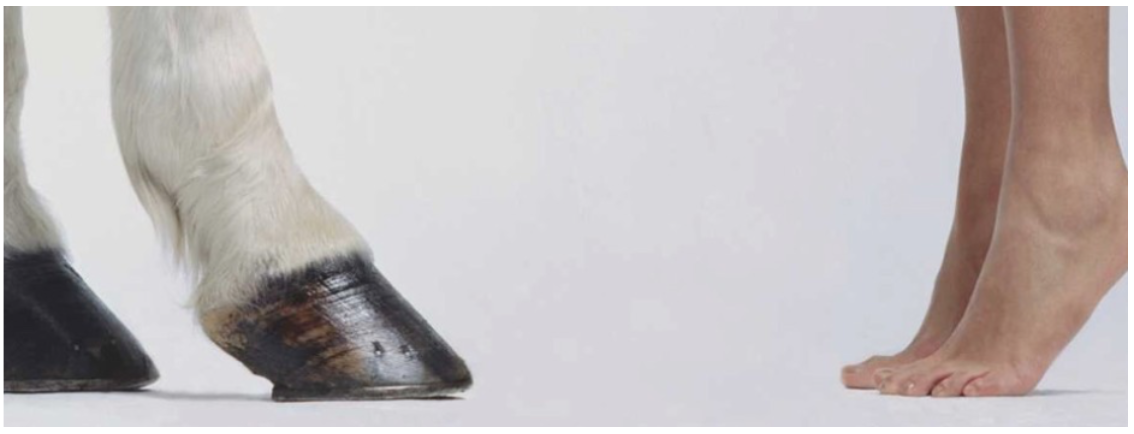
Ankle equinus occurs when the ankle joint lacks flexibility, particularly, the upward movement of ‘toes-to-shin’ (dorsiflexion). The word equinus is a pronounced as ‘equine’, with an ‘us’ at the end.
However, the word equinus actually is derived from the Latin root word ‘equues’ which relates to the family of horse like animals which all walk on their toes.
Childhood toe walking is the most extreme manifestation of equinus and is often observed in young children under the age of 2.
Toe walking toddlers tend to take all of their weight through the ball of the foot, without the heel contacting the ground. After the age of 2 most children grow out of toe walking.
Another form of adult ‘toe walking’ is the use of high heeled shoes. High heels and Morton’s neuroma unfortunately go hand-in-hand.
Although we never return to toe walking, some sporty adolescents and middle-aged adults start to take more pressure through the ball of the foot. The increased loading of the forefoot stems from tightness in the Achilles tendon or calf muscles, resulting in tightness of the ankle and reduced dorsiflexion AKA equinus. The equinus in turn increases the pressures under the ball of the foot and is often accompanied by a ‘bouncy’ gait.
This is because the heel has to compensate for the lack of ankle dorsiflexion by lifting off the ground a lot sooner than it would do normally, creating a seemingly ‘bouncy’ way of walking. Some people with equinus compensate in a different way to early heel lift and don’t have the bouncy gait, but instead they ‘abduct’ or turn the foot outwardly (think of how a clown walks). This abducted style of gait can also abnormally load up the plantar metatarsal region, also known as, 'the Morton’s neuroma danger zone'.
For most people, the equinus is caused by tight calf muscles & Achilles tendon. However, it can sometimes be caused by a ‘bony block’ in the ankle joint. Commonly, an extra piece of bone can jam the joint up. Extra bone can occur in either the front or the rear of ankle joint, and unfortunately for such people stretching exercises will not help.
The picture below demonstrates the Silfverskold test, which can separate whether the block is being caused by a bony block or more commonly, by the soft tissues.
The left-hand picture shows the limited range of ankle joint motion or ‘equinus’ with the leg is straight.
The right-hand picture shows that when the calf muscles and Achilles tendon are disengaged (by flexing the knee) a greater range of ankle joint motion is available, demonstrating the equinus is being caused by the soft tissues in the calf and not by a bony block in the ankle joint itself.

How much ankle joint dorsiflexion to I need?
Most experts agree that somewhere between 10-20 degrees is enough for good foot function. Less than 10 degrees is classified as equinus.
Why is equinus linked to Morton’s neuroma?
Studies that evaluate equinus and forefoot abnormalities and pressure in the plantar metatarsal region of the foot (the Morton's neuroma danger area), have shown that pressures in this critical region of the foot can more than double, causing forefoot issues and problems for various groups of patients (1,2,3,4).
A paper entitled “Equinus Deformity As A Factor In Forefoot Nerve Entrapment” published a case report of a fairly typical patient with equinus, that showed peak pressures under the plantar metatarsal region can be as high as 39 pounds per square inch, decreasing to 19 P.S.I. following successful restoration of ankle joint flexibility.
Quite simply, peak pressure can double in the forefoot with equinus (5).

A good quality Australian study looked at various factors, to see if they might be linked to Morton’s neuroma. The factors included body mass index (BMI) i.e. if patients were overweight or not, and foot posture index i.e. if patients had high or low foot arches and ankle equinus.
The study concluded:
“…No relationships were found between foot posture index and body mass index with intermetatarsal neuroma, or between foot posture index and the interspaces affected. However, a strong association was demonstrated between the presence of intermetatarsal neuroma and a restriction of ankle dorsiflexion.”
The association was incredibly strong and oddly, more so for the right foot. For every one degree of ankle joint dorsiflexion lost, the chances of developing a Morton’s neuroma increased by a staggering 63% for the right foot and a 43% in the left foot (6).
Why would equinus cause Morton’s neuroma?
In a word, Pressure.
Human peripheral nerves are quite susceptible to mechanical compressional pressure. Studies have shown pressure applied to the surface of the foot can be transmitted deeper into the foot resulting in damage to deeper nerves (7,8,9,). Doctors that study the effects of disease in tissues have speculated that Morton’s neuroma may be triggered by pressure related damage to the tiny blood vessels that supply the nerve, which in turn trigger a downward spiral of inflammation and proliferation of fibrotic nerve tissue (10,11,12).
Interestingly a more recent study found that individuals without Morton’s neuroma can also have degenerative changes to the nerve and nerve blood vessels (the study did not however follow-up those patients to see how many over time developed Morton’s neuroma, it probably would have been a high number). The study did however find that one of the most important differences between non-Morton’s neuroma interdigital nerves and Morton’s neuroma nerves was the presence of demyelination in the Morton’s neuroma nerves. In other words, Morton’s neuroma nerves have lower levels of myelin (12).
Although this particular blog is about the benefits of reversing equinus and not about the benefits of cryosurgery, I can’t talk about the demyelination of nerves, without shouting from the roof tops that cryosurgery is the only proven way to regenerate new myelin in the interdigital nerves.
Returning to equinus: In summary, ankle equinus causes increased forefoot pressures which in turn triggers Morton’s neuroma.
Therefore, it is vitally important to reduce the pressure under your forefoot. You can do this in two ways.
Firstly, by avoiding shoes with a high heel.
Secondly by reducing your ankle equinus. Thankfully ankle equinus responds very well to stretching exercises and a short program of stretching can help neuromas in their early stages, and can even provide welcome short-to-medium term relief for more advanced neuromas.
For a video demonstration of the best way to reverse ankle equinus follow this link, view the very first video, and forward to minute 3.
Footnotes for Runners:
If you are a runner its worth considering the fact that a lot of runners suffer from a tight Achilles and calf muscles. Contracture of these structures will inevitably contribute to ankle equinus. Furthermore, to add insult to injury, most running shoes have a positive degree heel, meaning that the heel sits typically 15-20 degrees higher than the forefoot. Evidence shows that over time a positive degree heel contributes to elevated pressures in the plantar metatarsal region (the Morton’s neuroma danger zone).
In summary, if you are a runner pay particular attention to your calf tightness and think about running shoes like 'Altra' that have a zero-degree heel.
Altra shoes in the UK can be difficult to source, At Morton’s neuroma we find they are commonly available from My Race kit www.myracekit.co.uk
References
- SAXENA A, KIM W: Ankle dorsiflexion in adolescent athletes. JAPMA 93: 312, 2003.
- BARRY DC, SABACINSKI KA, HABERSHAW GM, ET AL: Tendo Achilles procedures for ulcerations in diabetic patients with trans-metatarsal amputations. JAPMA 83:96, 1993.
- BLECK EE: Forefoot problems in cerebral palsy: diagnosis and management. Foot Ankle 4: 188, 1984.
- LAVERY LA, ARMSTRONG DG, BOULTON AJ: Ankle equinus deformity and its relationship to high plantar pressure in a large population with diabetes mellitus. JAPMA 92:479, 2002.
- Barrett, Stephen & Jarvis, Jason. (2005). Equinus deformity as a factor in forefoot nerve entrapment: Treatment with endoscopic gastrocnemius recession. Journal of the American Podiatric Medical Association. 95. 464-8. 10.7547/0950464.
- Naraghi, R., Bremner, A., Slack-Smith, L. et al. The relationship between foot posture index, ankle equinus, body mass index and intermetatarsal neuroma. J Foot Ankle Res 9, 46 (2016).
- CHABEL C, RUSSELL LC, LEE R: Tourniquet-induced limb ischemia: a neurophysiologic animal model. Anesthesiology 72: 1038, 1990.
- RORABECK CH: Tourniquet-induced nerve ischemia: an experimental investigation. J Trauma 20: 280, 1980.
- GRAHAM B, BREAULT MJ, MCEWEN JA, ET AL: Perineural pressures under the pneumatic tourniquet in the upper extremity. J Hand Surg[Br] 17: 262, 1992.

Morton’s Neuroma Treatment: Supplements, Self-Help & Cryosurgery
Supporting Nerve Health in Morton’s Neuroma Self-Help Strategies, Supplements, and When to Consider Cryosurgery Morton’s...
Read Post
Cryosurgery harnesses the body’s ability to repair and regenerate damaged peripheral nerves.
When it comes to nerve injuries many people have a mistaken perception that once a nerve is injured it can not repair....
Read Post
Should steroid injections for Morton’s neuroma be given without ultrasound guidance?
Introduction A 2016 study, that is frequently cited today, found minimal differences in outcomes, between Morton’s...
Read Post
Stepping back in time: A brief history of Cryosurgery in Medicine & a look at why it’s the ideal treatment for Morton’s Neuroma today.
Introduction In terms of safety, efficacy, and ease of patient recovery, cryosurgery in my view represents an unparalleled...
Read Post
Is it better to wait for Morton’s Neuroma to get worse before seeking treatment?
During the pandemic, like many others, I have been increasingly reflecting on my own personal quality of life re-prioritising...
Read Post
Case Study: Cryosurgery for Stump Neuroma
Introduction: The following is a case study of one of our stump neuroma success stories. Stump neuromas can cause life-limiting...
Read Post
Morton’s Neuroma and Bursal Complex. Which treatment is best?
What is bursal complex and what is the best treatment? There are approximately 150 bursae (the plural for bursa) throughout...
Read Post
Waiting Lists: 2 Years, or just 2 Weeks?
Approximately 87.5 people per 100,000 are affected by Morton’s neuroma. As those unlucky enough to be affected by...
Read Post
10 signs that you might have a Morton’s neuroma
During the Covid-19 Pandemic, many have found it hard access assessment and treatment for their suspected Mortons Neuroma....
Read Post
Ankle Equinus and Morton’s Neuroma
The Barn Clinic treatment centres in London & Sheffield commonly see a ‘silent’ condition that patients are...
Read Post
Mr Weaver has a special clinical interest in podiatric regenerative medicine and was among the first clinicians in Europe—and the first in the UK—to offer cryosurgery (cryoablation) for Morton’s neuroma. Driven by a commitment to excellence in patient care, he focuses on delivering precise, evidence-based treatments that prioritise long-term recovery and patient comfort.
Over the past 18 years, he has performed approximately 20,000 procedures for Morton’s neuroma and bursitis. This extensive experience allows him to provide a highly personalised approach, ensuring every patient receives the specialist attention required for the best possible outcomes.
His professional memberships include the Institute of Podiatrists, the International Society of Cryosurgery, and the British Medical Ultrasound Society.