Intermetatarsal Bursitis, a condition commonly mistaken for Morton’s neuroma
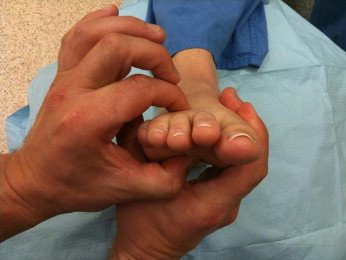
Table of Contents
Morton's Neuroma & intermetatarsal bursitis
If your 2020 new years’ resolution of, ‘taking up running’ has been thwarted by pain, numbness, and tingling under the forefoot during running, you might be forgiven for consulting Dr. Google and concluding that you have a Morton’s neuroma.
However, don’t throw away your running gear quite just yet, because Dr. Google, like many podiatrists, can’t easily distinguish between Morton’s neuroma and a similar condition called intermetatarsal bursitis; one that can be easily treated, and one that can’t be so easily treated with traditional methods. This inability to separate out bursitis from Morton’s neuroma is because both Morton’s neuroma and bursitis generate very similar sensations in the forefoot, and both can generate a positive ‘Mulder’s click’.
Mulder's Click.
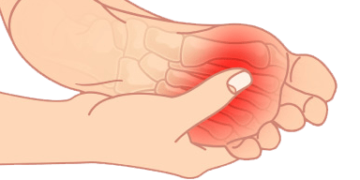
A ‘Mulder’s click’, regarded by many for decades, as the definitive test for the presence of Morton’s neuroma, can be felt by the examiner, and sometimes the patient too. The click occurs when the metatarsal bones are squeezed together whilst simultaneously applying an upward force with the thumb to the underside the forefoot, as seen below. The clicking sensation is generated by the ‘subluxation’ or upward displacement of the enlarged nerve against surrounding structures.
For many years Morton’s neuroma were, and still are by many, diagnosed purely on the basis of a positive squeeze test. The problem with this way of diagnosing Morton’s neuroma is that the Mulder’s squeeze test also detects bursitis. This is because bursa will frequently click if squeezed. This ‘false positive’ has been known about now for a long time, and discussed in the medical literature since at least 1985 (Bosley and others 1985).
So, as you can see, an examiner can’t really tell the patient “you have a Morton’s neuroma because you have a positive Mulder’s click” at best, all they could say is, “your positive Mulder’s click means you may have bursitis, or a Morton’s neuroma, or even a combination of both”.
Running and Bursitis.
Returning now to your new year’s resolution and running. If you have only felt discomfort, numbness and tingling during running and at no other time, especially if you run a lot uphill, the most likely culprit is not Morton’s neuroma, but intermetatarsal bursitis.
Intermetatarsal bursa (singular) or bursae (plural) are sac-like structures that normally contain a small amount of ‘lubricating’ synovial fluid. Sometimes but not always, they are connected to nearby joints. Their function is to reduce friction between structures that might otherwise become inflamed (in this case the interdigital nerve), if you like, they are a kind of internal buffering mechanism. There are 160 bursae found all over the body (Lohr, KM. 2016).
These bursae can become problematic when inflamed, because they fill up dramatically with synovial fluid, the walls of the sac can thicken and harden and sometimes calcify, overall, a process called bursitis. Over time, the bursa press-on, and ultimately compress the nerves in the forefoot, causing pain and sometimes Morton’s neuroma. It is also worth remembering that bursae occur quite normally and harmlessly between 1st - 2nd metatarsals and the 4th - 5th metatarsal.
In those locations they are described ‘anatomical’ because they are a normal anatomic feature, a feature that we are all born with. Bursa can also develop over time in places where we weren’t born with them. These are known as ‘adventitious’. Adventitious bursa, develop at mechanical irritation ‘hot spots’ and are particularly prone to inflammation in the 2nd - 3th and 3rd - 4th interspaces, especially if someone is running in shoes too tight in the toe box, that squeeze the contents of the forefoot together, or if the soles of the shoes are too thin, causing irritation from tree roots and stones and pavement potholes from below.
In runners, as the bursa become inflamed they press on the interdigital nerves causing a sensation of fullness in the forefoot, accompanied by numbness and tingling. Usually these sensations typically wear off shortly after the run stops.
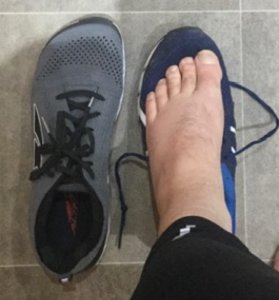
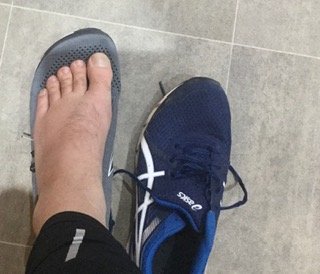
For many runners, myself included, the symptoms from bursitis can often be addressed by changing running shoes. Simply changing from a shoe with a tapered toe box (seen below on the left, with my foot resting on a traditional Ascis shoe with a tapered toe box) to a shoe with a more ‘squared off’ toe box, will resolve the bursitis (seen on the right, with my own Altra paradigm 4.5s).
Tapered Toe Box
Tapered shoe boxes can constrict the foot and lead to the development of bursa and Morton's neuroma.
Squared-Off Toe Box
Choosing a shoe with a 'squared-off' toe box offers runners less side-ways compression on the forefoot.
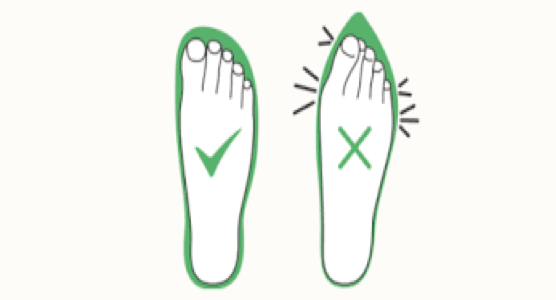
The diagram above shows the side-ways constriction of the toes and forefoot in shoes with a narrow toe box.
My recommendation to patients with wider feet and bursitis, is to try Altra shoes. Not only are they wider in the toe box, they also don’t load up the forefoot in the same way as other running shoes, due to the heel and toes sitting at the same level; which is unlike most running shoes, that place the heel higher than the forefoot. Failing Altra, Brooks are often a good bet, with a broader last, but for those with a slightly narrower forefoot, should look at the Hoka range. You can read at little more about Altra Zero Drop Shoes in one of our previous blog posts here.
If you find that the numbness, pain, and tingling continue well into your non-running day-to-day life, it generally means you have either developed a very inflamed nasty bursa, that will require rest and expert management or worse still, your bursa may be evolving into a Morton’s neuroma.
How are Bursa best diagnosed?
With high-quality ultrasound imaging equipment. With such equipment, an expert in forefoot problems can easily distinguish between a bursa and a neuroma within a matter of minutes. Why is it important to distinguish between bursa and Morton’s Neuroma? Because, otherwise without imaging there is no way of knowing if the pain is coming from a neuroma or a bursa.
From a surgical perspective, bursae when ‘excised’ or cut out are removed with the nerve as one combined unit, this is because the nerve and bursa are closely entwined. So, to answer the last question in other way, why would you have a healthy nerve removed if the issue is a bursa?
For at least half of those with bursa pain, the pain can generally be addressed with simple changes, with running for instance, simply avoiding running up hill will often calm them down. Failing that, injections of steroid or newer non-steroid treatments can encourage the bursa to calm down and empty, and ultimately become pain free.
What happens if conservative treatments for bursitis fail?
Cryosurgery has long represented an effective and superior treatment for bursitis over conservative treatments. This is illustrated by a study involving 170 patients, dating back to 1988 study entitled “…treatment of bursitis by a local cryogenic procedure.” It showed at followed-up, (between 12 and 24 months) that just under half of those treated with usual conservative measures were free of bursitis, compared to 100% of patients who remained bursitis-free following cryosurgery (Goriachev An, and others.1988).
At ‘The Barn Clinic’ treatment centres in London and Sheffield, we routinely perform cryosurgery for forefoot pain that stems from bursitis or Morton’s neuroma or even for those with a combination of both Morton’s neuroma and bursitis.
Similar to cryosurgery for Morton’s neuroma, Cryosurgery treatment of bursae, usually results in a small patch of numbness at the base of the toes and of the two toes of the affected metatarsal interspace. The numbness typically wears off after 3-4 months. We usually recommend waiting until total pain relief has been achieved before returning to running. Even when total pain relief is obtained within the first couple of weeks post cryosurgery, we still recommend not running for 6 weeks to allow the tissues time to recover. The minimum rest time after cryosurgery before returning to running is 6 weeks, however cycling and cross training can be undertaken with guidance after 2 weeks.
For more information about cryosurgery for bursitis or Morton’s neuroma, diagnostic ultrasound scans, injection therapy and other conservative treatment options please contact the clinic for more information.
References
- Bosley CJ, Cairney PC. The inter metatarsal phalangeal bursa - its significance in Morton’s Metatarsalgia. J Bone Joint Surg. 1980;62(2):184–7
- Goriachev AN, Ivashchenko NM, Potapov IuA. Treatment of bursitis by a local cryogenic procedure.Vestn Khir Im I I Grek. 1988 Jan;140(1):128-31.
- Lohr KM: Bursitis. Medscape Drugs and Diseases. New York, NY 2016. Available from: http://emedicine.medscape.com/article/2145588-overview
Morton’s Neuroma Treatment: Supplements, Self-Help & Cryosurgery
Supporting Nerve Health in Morton’s Neuroma Self-Help Strategies, Supplements, and When to Consider Cryosurgery Morton’s...
Read PostCryosurgery harnesses the body’s ability to repair and regenerate damaged peripheral nerves.

When it comes to nerve injuries many people have a mistaken perception that once a nerve is injured it can not repair....
Read PostShould steroid injections for Morton’s neuroma be given without ultrasound guidance?
Introduction A 2016 study, that is frequently cited today, found minimal differences in outcomes, between Morton’s...
Read PostStepping back in time: A brief history of Cryosurgery in Medicine & a look at why it’s the ideal treatment for Morton’s Neuroma today.
Introduction In terms of safety, efficacy, and ease of patient recovery, cryosurgery in my view represents an unparalleled...
Read PostIs it better to wait for Morton’s Neuroma to get worse before seeking treatment?
During the pandemic, like many others, I have been increasingly reflecting on my own personal quality of life re-prioritising...
Read PostCase Study: Cryosurgery for Stump Neuroma
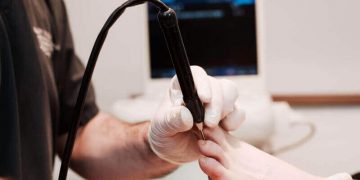
Introduction: The following is a case study of one of our stump neuroma success stories. Stump neuromas can cause life-limiting...
Read PostMorton’s Neuroma and Bursal Complex. Which treatment is best?
What is bursal complex and what is the best treatment? There are approximately 150 bursae (the plural for bursa) throughout...
Read PostWaiting Lists: 2 Years, or just 2 Weeks?

Approximately 87.5 people per 100,000 are affected by Morton’s neuroma. As those unlucky enough to be affected by...
Read Post10 signs that you might have a Morton’s neuroma
During the Covid-19 Pandemic, many have found it hard access assessment and treatment for their suspected Mortons Neuroma....
Read PostAnkle Equinus and Morton’s Neuroma
The Barn Clinic treatment centres in London & Sheffield commonly see a ‘silent’ condition that patients are...
Read Post

Mr Weaver has a special clinical interest in podiatric regenerative medicine and was among the first clinicians in Europe—and the first in the UK—to offer cryosurgery (cryoablation) for Morton’s neuroma. Driven by a commitment to excellence in patient care, he focuses on delivering precise, evidence-based treatments that prioritise long-term recovery and patient comfort.
Over the past 18 years, he has performed approximately 20,000 procedures for Morton’s neuroma and bursitis. This extensive experience allows him to provide a highly personalised approach, ensuring every patient receives the specialist attention required for the best possible outcomes.
His professional memberships include the Institute of Podiatrists, the International Society of Cryosurgery, and the British Medical Ultrasound Society.