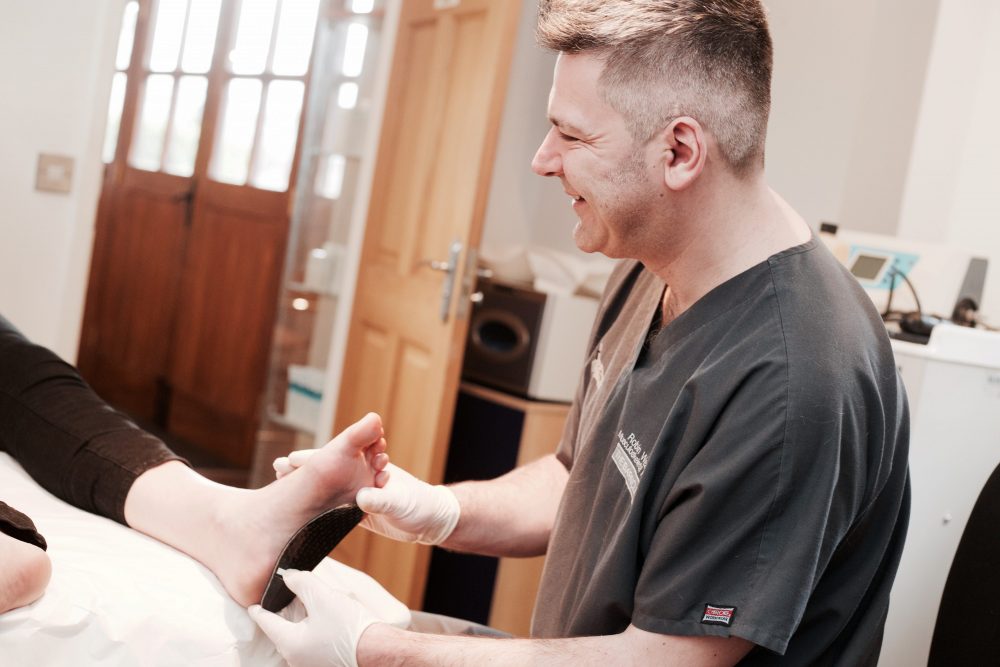
Orthotics for Morton’s Neuroma
Table of Contents
Do Orthotics help reduce Morton's Neuroma pain?
Our understanding of the answer to this question is based on two things.
- The findings of a 1994 Study
- Our own day to day clinical experiences of treating 1000s of Morton’s neuroma sufferers with modern orthotics.
1994, as well as being the year the Spice Girls got together and Oasis released their first album ‘Definitely maybe', was the year that the first and more or less only study into the benefit of orthotics for Morton's neuroma was published. It evaluated the effect of using foot orthotics, and particularly their effects on Morton’s neuroma sufferers pain levels.
It showed that depending on foot type, orthotics offered a 45% reduction for pronated (flatter) feet, and 50% reduction for supinated (high arch feet).
The study had a few weaknesses by modern standards. One, being participants had no prior ultrasound imaging to exclude the presence of co-existing problems that sometimes go hand in hand Morton’s neuroma such as arthritis, bursitis, capsulitis etc. Overall, the author did an excellent job with the limited resources available to a UK NHS Podiatry department in 1994. This research has not been significantly updated since 1994.
Why hasn't this work been updated?
One of the reasons that this research has not been updated is that it is difficult to find a group of Morton’s Neuroma sufferers who are happy to agree to have no treatment other than orthotics for their neuroma pain for a period of months. This agreement, to have no other treatment, is a requirement of modern study methodology. This is because the scientific validity of a study is undermined if participants use orthotics as well as other treatments, such as physio, stretching icing, anti-inflammatory medications etc. If patients simultaneously use other treatment options, the researchers find it very hard to determine the single effect of using orthotics.
So, to recap, according to the study, orthotics in the distant days of the Spice Girls had a pretty good success rates, a 45% reduction for pronated (flatter) feet, and 50 % reduction for supinated (high arch feet).
What about today?
Our understanding of biomechanics and orthotics have moved on a long way since 1994.
These days we are able help a lot more than 50% of patients. The figure in 2019 based on my own experience and based on discussions with colleagues, is a lot closer to the region of between 70-80%.
Approximately 70-80% of patients with established neuromas will see a reduction in their pain levels. It is also our experience that with smaller neuromas, the pain can often totally resolve (whilst the orthotics are being used).
What is responsible for the improvement?
There is no doubt that modern orthotic manufacturing, helped by computer aided design and 3D printing, has come on a long way since 1994. Such improvements have allowed Podiatrists to design and prescribe ever more complex devices, which have probably helped raise overall success rates.
However, it’s not just orthotic manufacturing that has evolved. Our understanding of biomechanics has altered significantly since 1994.
When I was a Podiatry undergraduate in the 1990’s a lot of emphasis was placed on ‘kinematics’ or the visual ‘alignment’ or appearance of joints and foot position. Subsequent studies have shown that Kinematics are far less important than we first thought.
In 2019 most podiatrists subscribe more to the tissue stress model, and attempt to alter and manipulate the 3 key variables that are involved in damaged overloaded tissues.
The 3 variables are:
- Magnitude of reaction forces.
- Vector of reaction forces.
- The temporal pattern of reaction forces.
Normally at this point in a blog, I generally attempt to simply and summarise scientific data. But when it comes to the 3 variables above, on this occasion you will simply have either complete a degree in biomechanics or take my word for the fact those 3 variables are not easily broken down into understandable bite sized pieces. Especially how they are applied to orthotics, it is complicated... very complicated!
So, is the improvement simply down to better quality orthotics and an improved understanding of biomechanics?
Possibly, but I doubt it is just down to those factors alone.
Our treatment planning involves a very detailed biomechanical assessment that involves ultrasound imaging and elastography imaging of the forefoot. This type of extra imaging data provides a wealth of knowledge.
For instance, a scan will alert us to the presence of co-existing issues that often go hand in hand with Morton’s neuroma, conditions such as arthritis, bursitis capsulitis plantar plate degeneration etc. When we see such issues, we can now alter the design of the orthotic accordingly, making a better outcome for the patient more likely.
So, how do orthotics reduce pain?
Orthotics are constructed using corrected 3d models of your own feet. The process of taking the casts of your feet is a highly skilled process that enables your clinician to realign your joints as they take the impressions. When the impressions are poured, orthotists generally make angular corrections to the models of your feet. After this process has been completed, the orthotics are then moulded over the corrected models of your feet.
We know from modern studies that orthotics can reduce abnormal overloading mechanical forces responsible for Morton’s neuroma formation. Some orthotics also have domes that lift and separate the metatarsal bones creating room for the neuroma to sit in.
Orthotics also help reduce the hammering or retraction of the lesser toes. This is very helpful because hammered toes contribute to elevated pressures in the forefoot region.
Orthotics - Myth Buster
-
-
-
- Orthotics act as a brace and orthotics weaken the muscles of the feet.Electromyography (EMG) is a branch of medicine that for evaluates and records the electrical activity produced by skeletal muscles, it can be used to assess the muscles in the feet and legs during walking and running.
A ground breaking 2009 paper entitled “Effect of foot posture (foot type), foot orthotics and footwear on lower limb muscle activity during walking and running: a systematic review, found the evidence does not support the idea that orthotics act as a foot brace or using orthotics causes muscle weakness. This paper was a quality study that collated the findings of 38 published studies. It actually found the opposite. It showed that the muscles of people who had certain foot types that included flat pronated feet only started working normally when the subject used orthotics. There is no evidence that using orthotics is detrimental, quite the opposite. - Orthotics are uncomfortable. Custom made orthotics are orthotics made over models of your own feet. As such the vast majority of our patients find their orthotics comfortable to wear from day one.
- Orthotics are expensiveHigh quality carbon fibre orthotics are very durable often lasting many years, and cost as little as £350. Which is approximately £29.17 a month through our 12 Month Interest free Credit Plan.
- All orthotics are the same.
Orthotics purchased from a pharmacy or a trade fair are in no way comparable to quality prescription devices that are prescribed and fabricated to a prescription unique to your feet. At The Barn Clinic treatment centres we have over 20 years of experience dispensing Morton’s neuroma.
- Orthotics act as a brace and orthotics weaken the muscles of the feet.Electromyography (EMG) is a branch of medicine that for evaluates and records the electrical activity produced by skeletal muscles, it can be used to assess the muscles in the feet and legs during walking and running.
-
-
The take home message
- Custom made and even pre-made orthotics can be very helpful in managing Morton’s neuroma pain
- Modern manufacturing methods allow for smaller more user-friendly orthotics
- Ultrasound imaging when combined with a detailed biomechanical assessment can provide better outcomes for patients
- Orthotics are highly individual and totally dependent of the skill and experience of the clinician providing them
Will my Morton's Neuroma benefit from orthotics?
Well to quote my favourite album of 1994 in the words of Oasis…Definitely Maybe.
They don’t work for everyone but they certainly help the vast majority.
Morton’s Neuroma Treatment: Supplements, Self-Help & Cryosurgery
Supporting Nerve Health in Morton’s Neuroma Self-Help Strategies, Supplements, and When to Consider Cryosurgery Morton’s...
Read PostCryosurgery harnesses the body’s ability to repair and regenerate damaged peripheral nerves.
When it comes to nerve injuries many people have a mistaken perception that once a nerve is injured it can not repair....
Read PostShould steroid injections for Morton’s neuroma be given without ultrasound guidance?
Introduction A 2016 study, that is frequently cited today, found minimal differences in outcomes, between Morton’s...
Read PostStepping back in time: A brief history of Cryosurgery in Medicine & a look at why it’s the ideal treatment for Morton’s Neuroma today.
Introduction In terms of safety, efficacy, and ease of patient recovery, cryosurgery in my view represents an unparalleled...
Read PostIs it better to wait for Morton’s Neuroma to get worse before seeking treatment?
During the pandemic, like many others, I have been increasingly reflecting on my own personal quality of life re-prioritising...
Read PostCase Study: Cryosurgery for Stump Neuroma
Introduction: The following is a case study of one of our stump neuroma success stories. Stump neuromas can cause life-limiting...
Read PostMorton’s Neuroma and Bursal Complex. Which treatment is best?
What is bursal complex and what is the best treatment? There are approximately 150 bursae (the plural for bursa) throughout...
Read PostWaiting Lists: 2 Years, or just 2 Weeks?
Approximately 87.5 people per 100,000 are affected by Morton’s neuroma. As those unlucky enough to be affected by...
Read Post10 signs that you might have a Morton’s neuroma
During the Covid-19 Pandemic, many have found it hard access assessment and treatment for their suspected Mortons Neuroma....
Read PostAnkle Equinus and Morton’s Neuroma
The Barn Clinic treatment centres in London & Sheffield commonly see a ‘silent’ condition that patients are...
Read Post
Mr Weaver has a special clinical interest in podiatric regenerative medicine and was among the first clinicians in Europe—and the first in the UK—to offer cryosurgery (cryoablation) for Morton’s neuroma. Driven by a commitment to excellence in patient care, he focuses on delivering precise, evidence-based treatments that prioritise long-term recovery and patient comfort.
Over the past 18 years, he has performed approximately 20,000 procedures for Morton’s neuroma and bursitis. This extensive experience allows him to provide a highly personalised approach, ensuring every patient receives the specialist attention required for the best possible outcomes.
His professional memberships include the Institute of Podiatrists, the International Society of Cryosurgery, and the British Medical Ultrasound Society.